

A vehicle tracker is defined as an electronic device that records and transmits real-time location data, giving insurers verifiable evidence to validate or reject a claim. The role of tracker in insurance claim processing has grown significantly, with Tracker Network UK recovering £41 million worth of stolen vehicles in 2025 alone, reducing insurer claim costs by £4 million in the same period. Thatcham Research, the UK’s central automotive risk intelligence organisation, independently certifies these devices, and insurers rely on those ratings to assess theft risk and set premiums. Understanding how trackers work within the claims process gives you a clear advantage when dealing with your insurer.
How does the role of tracker in insurance claim outcomes work?
Tracker data provides an indisputable, timestamped record of a vehicle’s location and movement. Insurers use this record to verify that a theft claim is genuine, confirm the time and location of an incident, and rule out fraud. Without that data, a claim rests largely on the owner’s account alone.
The practical impact is substantial. Tracking technology achieved a 95% Stolen Vehicle Recovery success rate in 2025, with 80% of recovered vehicles returned within 24 hours. Faster recovery means the insurer avoids a total-loss payout, which is the most expensive outcome on any motor policy.

Tracker data also supports insurer confidence when underwriting higher-risk vehicles. Over 180,000 tracker devices have been supplied to UK insurers over six years, enabling confident underwriting of vehicle categories that would otherwise attract prohibitive premiums. That scale reflects how central tracking technology has become to modern motor insurance.
Key ways tracker data influences a claim:
- Timestamped location logs confirm exactly when and where a vehicle was taken, removing ambiguity from the claim.
- Movement history shows whether the vehicle was driven after theft, supporting police recovery operations.
- Geofence alerts provide documented evidence that the owner was not in the vehicle at the time of the incident.
- Recovery coordination links directly with police patrols and helicopters, accelerating the physical retrieval of the vehicle.
- Fraud prevention protects honest claimants by making false claims far harder to submit successfully.
Pro Tip: Request a full data report from your tracker provider as soon as you report a theft. Submit this alongside your initial claim, not as an afterthought. Insurers process claims faster when timestamped evidence arrives with the first notification.
GPS vs multi-technology trackers: which performs better in claims?
Not all trackers carry equal weight with insurers. The technology inside the device determines how reliably it performs in real theft scenarios and how much credibility it carries during the claims process.
GPS-only trackers rely on satellite signals. They work well in open areas but fail in underground car parks, metal-lined containers, and signal-jammed environments. Thieves who target high-value vehicles frequently use GPS jammers, making a GPS-only device vulnerable to defeat.
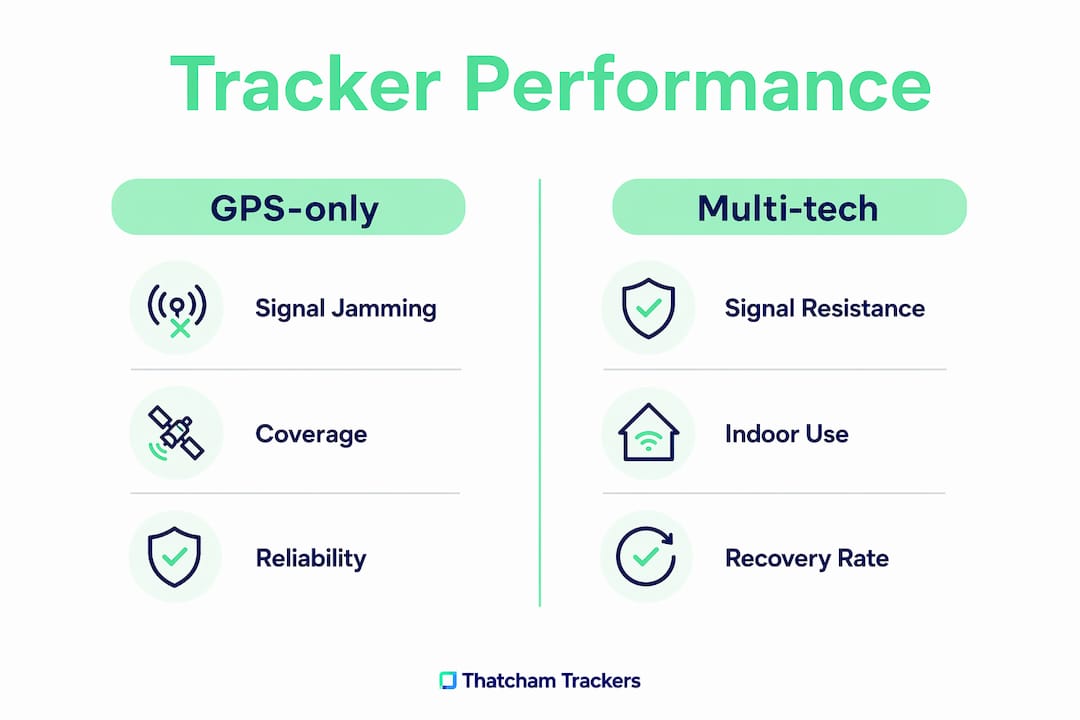
Multi-technology trackers combining VHF, GPS, and GSM outperform GPS-only devices by overcoming signal jamming and maintaining tracking in challenging environments. VHF signals penetrate metal and concrete where GPS cannot reach. GSM provides network-based location when satellite signals are blocked. The combination means the tracker continues to function even when a thief attempts to disable one signal type.
| Feature | GPS-only tracker | Multi-technology tracker (VHF/GPS/GSM) |
|---|---|---|
| Signal jamming resistance | Low | High |
| Underground tracking | Poor | Strong |
| Police helicopter integration | No | Yes |
| Thatcham approval eligibility | Limited | Full (S5, S5 Plus, S7) |
| Insurer premium discount | Minimal | Significant |
| Recovery success rate | Lower | Up to 95% |
Thatcham Research certifies trackers at different security levels. The Thatcham Approved S5 and Thatcham Approved S7 categories represent the most widely accepted standards among UK insurers. An S5 device includes a driver recognition system, while an S7 device adds stolen vehicle response monitoring by a 24-hour control centre.
Pro Tip: Check your insurer’s specific approval requirements before purchasing a tracker. Some policies name the exact Thatcham category required. Fitting the wrong category means the device may not qualify for a premium discount or may not satisfy a policy condition.
How to manage your insurance claim using tracker data and claim tracking
Active claim management separates vehicle owners who receive prompt settlements from those who wait months without resolution. Tracker data gives you a factual foundation. Organised documentation gives you the means to use it.
The first step is to create a claim delay log from the moment you report the incident. This is a written record of every contact with your insurer, including the date, the name of the person you spoke with, what they promised, and the deadline they gave. A manual claim delay log shifts you from a passive claimant to an organised claim manager, improving insurer responsiveness and creating a paper trail that can be used to escalate disputes.
Phone calls alone are invisible in documentation and do not count as proof. After every call, send a brief email to your insurer summarising what was discussed and what was agreed. This creates a written timeline that supports any escalation if the claim stalls.
Follow these steps to manage your claim effectively:
- Report and document immediately. Note the exact time and date you reported the theft or incident to both the police and your insurer.
- Request your tracker report. Contact your tracker provider and ask for a full location and movement history covering the relevant period.
- Submit tracker data with your claim. Attach the tracker report to your initial claim submission rather than waiting for the insurer to request it.
- Start your claim delay log. Record every insurer contact, including names, dates, promises made, and deadlines given.
- Follow up calls with emails. Send a written summary after every phone conversation to create a documented record.
- Monitor your claim status actively. Tracking claim status provides early warnings of additional document requests and avoids delays caused by missing information.
- Escalate with evidence. If a deadline passes without action, send your insurer a formal written summary of all missed commitments, referencing your log and the tracker data submitted.
Pro Tip: Ask your insurer to confirm in writing which documents they still require. Vague verbal assurances that a claim is “being processed” are not sufficient. A written confirmation of outstanding requirements gives you a clear target and a record if the claim is later delayed.
What impact do trackers have on insurance premiums and policy requirements?
Insurers reduce premiums for vehicles fitted with insurance-approved trackers because the theft risk and total-loss exposure are measurably lower. The discount reflects the insurer’s confidence that the vehicle can be recovered quickly if stolen, reducing the likelihood of a large payout.
For certain vehicle categories, a Thatcham-approved tracker is not optional. High-value cars, performance vehicles, and some commercial vehicles are routinely subject to policy conditions that require active tracker installation as a term of cover. Failing to maintain an active subscription on a required tracker can void the relevant policy benefit or, in some cases, the policy itself.
Key policy and premium points vehicle owners should know:
- Premium discounts are available when a Thatcham-approved device is fitted and the subscription is active.
- Policy conditions on high-value vehicles often specify the minimum Thatcham category required, such as S5 or S7.
- Subscription costs vary by device and provider. Most Thatcham-approved trackers carry an annual monitoring fee, which is separate from the purchase price.
- Insurer acceptance criteria differ. Some insurers accept S5 devices; others require S7 with 24-hour monitoring. Confirm the requirement before installation.
- Lapsed subscriptions can invalidate the policy condition, meaning the premium discount may be withdrawn or a claim may be affected if the monitoring service was inactive at the time of theft.
The importance of claim tracker compliance extends beyond the initial purchase. Keeping the subscription active and the device serviced is as important as the installation itself.
Key takeaways
A Thatcham-approved tracker is the single most effective tool a vehicle owner can fit to protect both the vehicle and the insurance claim outcome.
| Point | Details |
|---|---|
| Tracker data validates claims | Timestamped location records give insurers verifiable evidence, reducing fraud and speeding settlement. |
| Multi-technology devices outperform GPS-only | VHF, GPS, and GSM combined resist jamming and maintain tracking in environments where GPS fails. |
| Active claim logging prevents delays | A written claim delay log with dates and promises creates the paper trail needed to escalate stalled claims. |
| Thatcham approval determines insurer acceptance | Only Thatcham Research-certified devices qualify for premium discounts and satisfy policy conditions. |
| Subscription must stay active | A lapsed tracker subscription can void the policy benefit and affect claim outcomes if theft occurs. |
Thatcham Trackers’ view on trackers and claims management
From our experience working with vehicle owners across the UK, the most common mistake is treating a tracker as a passive device. Owners fit it, forget it, and assume it will handle everything automatically when a claim arises. That assumption costs people money and time.
The tracker provides the evidence. The owner still needs to use that evidence actively. We have seen claims where the tracker data was available but never submitted with the initial claim, causing weeks of unnecessary delay while the insurer requested documentation that was already sitting in the owner’s inbox.
The second pattern we observe consistently is poor communication management. Owners rely on phone calls, receive verbal assurances, and then find those assurances are not honoured. A written record of every insurer contact, backed by tracker data, is the combination that produces fast, fair settlements.
Thatcham Research certification matters more than price when choosing a device. A cheaper, non-approved tracker may record location data, but it carries no weight with an insurer assessing a claim. The approval mark is the insurer’s signal that the device meets a tested, independent standard.
Organised owners with approved devices and documented claims get better outcomes. That is not opinion. It is the pattern we see repeatedly.
— Thatcham Trackers
Thatcham-approved trackers for your vehicle
Vehicle owners who want insurer-accepted protection and faster claim outcomes need a device that meets the standard insurers actually recognise.
Thatcham Trackers supplies a full range of Thatcham-approved trackers independently certified by Thatcham Research. The range covers S5, S5 Plus, and S7 categories, giving vehicle owners the right device for their insurer’s specific requirements. Each device is backed by professional installation and active monitoring, keeping the subscription compliant and the policy condition satisfied. Thatcham Trackers is rated 4.8 out of 5 on both Trustpilot and Google Reviews. For guidance on which device suits your vehicle and policy, contact Thatcham Trackers directly.
FAQ
What is the role of a tracker in an insurance claim?
A tracker provides timestamped location and movement data that insurers use to verify theft claims, support vehicle recovery, and reduce total-loss payouts. Thatcham-approved devices carry the most weight with UK insurers.
Do I need a Thatcham-approved tracker for my insurance?
Many UK motor policies, particularly for high-value and performance vehicles, require a Thatcham Research-certified tracker as a condition of cover. Check your policy schedule for the specific category required.
How does tracker data speed up a claim settlement?
Submitting a tracker report with your initial claim gives the insurer immediate, verifiable evidence. This removes the need for extended investigation and reduces the time between claim submission and settlement.
Can a tracker prevent my claim from being rejected?
Tracker data significantly reduces the risk of a fraud-related rejection by providing an independent, timestamped record of the incident. It does not guarantee approval but removes the main grounds for dispute on theft claims.
What happens if my tracker subscription lapses during a claim?
A lapsed subscription means the monitoring service was inactive at the time of theft. This can void the policy condition linked to the tracker, potentially affecting premium discounts and the insurer’s willingness to rely on the device data.