

TL;DR:
- Most UK sports and high-value car owners need Thatcham Category S5 trackers to meet insurer requirements. Installing an accredited device with a digital certificate of conformity protects against theft claims and ensures insurer acceptance, especially for vehicles valued above approximately £50,000. Choosing the right tracker depends on vehicle value, storage environment, and insurer specifications, with S5 Plus offering added immobilisation and VHF features for very high-value or enclosed storage vehicles.
For most sports and high-value cars in the UK, insurers commonly require a minimum of Thatcham Category S5. For vehicles valued above approximately £50,000, or those with a high theft-risk profile, S5 Plus is increasingly the standard insurers expect. The sports car Thatcham tracker requirement is not a formality — without the correct category and a digital certificate of conformity from an accredited installer, a theft claim can be rejected outright.
Three actions to take now:
- Check your policy schedule for the exact Thatcham category wording your insurer specifies.
- Confirm in writing with your insurer which category (S5, S5+, or S7) they will accept and whether remote immobilisation is required.
- Book a professional installation from an accredited technician and ensure you receive a digital certificate of conformity at handover.
Thatcham Research independently tests and certifies tracking devices against defined criteria. S5 systems, introduced in 2019, are specifically designed for high-value or high-risk vehicles and mandate a driver identification device, 24/7 monitored tracking, and tamper resistance. S7 provides asset-level location tracking without mandatory driver ID. Certification confirms device capability; it does not guarantee insurer acceptance, which is why written confirmation from your insurer is non-negotiable.
Pro Tip: Ask your insurer specifically: “Does my policy require a Thatcham Category S5 or S5+ tracker, and will you accept a digital certificate of conformity from an accredited installer as proof?” Get the answer in writing before booking any installation.
Table of Contents
- Why are sports cars targeted, and why does Thatcham category matter?
- What is the difference between Thatcham S5 and S7?
- How do insurers use Thatcham categories in policy terms?
- What counts as an accredited installation in the UK?
- Which tracker features matter most for sports cars?
- What do sports car trackers typically cost?
- How to choose the right Thatcham tracker for your sports car
- When is S5 Plus worth the extra cost?
- How Thatcham Trackers meets insurer requirements for sports cars
- Key takeaways
- The case for getting this right the first time
- Thatcham Trackers: accredited installation for sports cars across the UK
- Useful sources
- FAQ
Why are sports cars targeted, and why does Thatcham category matter?
Sports and prestige cars attract thieves for straightforward reasons: high resale value, strong demand for parts, and in many cases, keyless entry systems that are vulnerable to relay attacks. Insurers are acutely aware of this risk profile and factor it directly into underwriting decisions.
Thatcham certification reduces insurer uncertainty by providing an objective, independently verified record of a device’s performance, tamper resistance, and recovery capability. When an insurer sees a Thatcham-approved device with a valid certificate of conformity, they have documented evidence that the system meets a defined standard — rather than relying on a manufacturer’s marketing claims.
The threshold where insurers commonly insist on a certified tracker sits at vehicles valued at higher amounts where insurance policies typically require more stringent security. Below that, some insurers may accept a non-certified device or none at all; above it, a Thatcham-approved tracker is frequently a condition of cover, not merely a route to a discount.
What insurers expect an approved tracker to deliver:
- A measurable increase in vehicle recovery probability if stolen.
- Documented tamper resistance that deters removal before a theft.
- 24/7 monitoring with a response centre that can alert police.
- Reduced risk of a claim being rejected due to inadequate security.
- Evidence of professional installation through a digital certificate.
What is the difference between Thatcham S5 and S7?
Category S5 and S7 are both professionally fitted tracker categories that insurers will accept, but they serve different risk profiles. S5 is the category built for high-value and high-risk vehicles; S7 is the entry-level option for general asset tracking.
Thatcham S5: what it requires
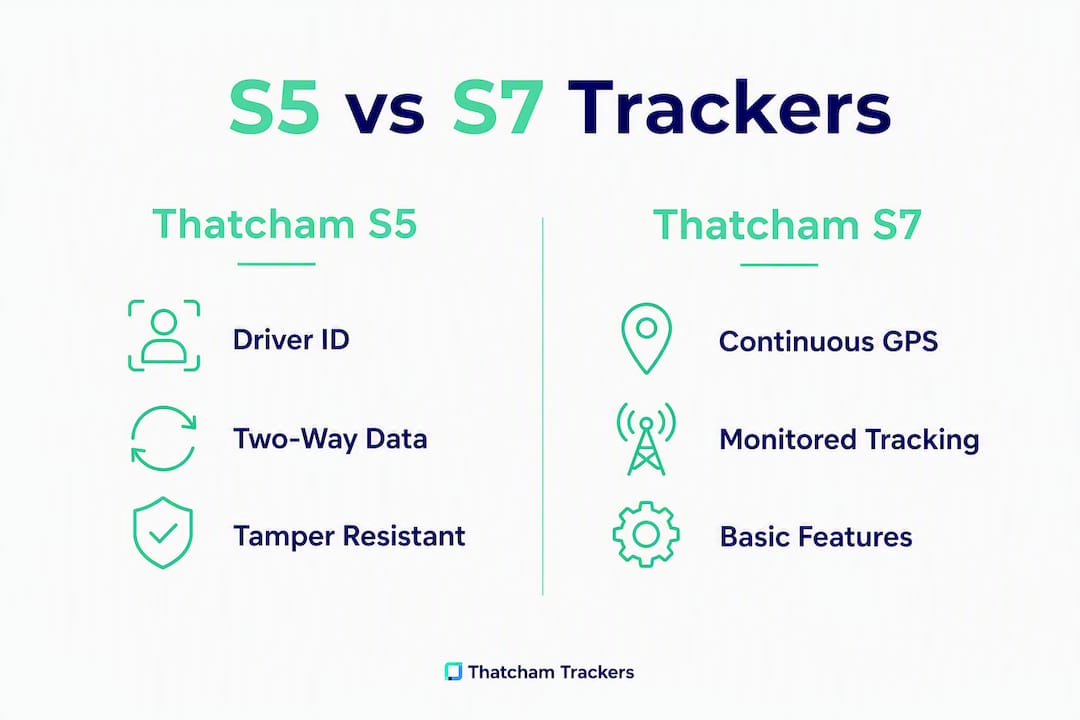
S5 systems mandate a driver identification device — typically a tag attached to the key. Starting the car without the tag triggers an alert to the monitoring centre. Beyond driver ID, S5 devices must provide 24/7 monitored GPS tracking, motion detection, a roaming SIM for cross-network coverage, battery back-up, bi-directional data transmission, and a minimum two-minute resistance to physical attack. They must also meet BS 8591 remote centre monitoring standards or an equivalent.
Thatcham S7: what it provides
S7 is the entry level for professionally fitted trackers that insurers will accept. It provides continuous GPS location tracking accurate to within one mile or closer, 24/7 monitoring, and tamper alerts. Driver identification is not a mandatory feature under S7. For a sports car owner, S7 may be sufficient if the insurer accepts it in writing and the vehicle’s value and risk profile do not demand S5.
Where S5 Plus fits
S5 Plus extends the S5 standard with remote immobilisation (deployed under police guidelines) and VHF radio capability. VHF allows a monitoring centre to locate a vehicle in environments where GPS signals are blocked or jammed — underground car parks, shipping containers, and dense urban areas. For very high-value sports cars or those regularly stored in enclosed spaces, S5+ is the more resilient choice.
| Feature | S7 | S5 | S5 Plus |
|---|---|---|---|
| 24/7 monitored tracking | Yes | Yes | Yes |
| GPS location accuracy | Within 1 mile or closer | High accuracy | High accuracy |
| Driver ID (mandatory) | No | Yes | Yes |
| Roaming SIM | Yes | Yes | Yes |
| Battery back-up | Yes | Yes | Yes |
| Bi-directional data | No (not mandatory) | Yes | Yes |
| Tamper resistance | Yes | Min. 2-minute attack resistance | Min. 2-minute attack resistance |
| Remote immobilisation | No | No | Yes (police-approved use) |
| VHF radio | No | No | Yes |
| Typical insurer use case | Moderate-value vehicles | High-value / sports cars | Very high-value / enclosed storage |
How do insurers use Thatcham categories in policy terms?
Insurers specify tracker requirements in the policy schedule, not always in the main policy document. The schedule is where you will find wording such as “a Thatcham Category S5 approved tracking device must be fitted and active.” If that wording is absent, the insurer may still require a tracker as a general condition of cover — which is why reading the schedule carefully matters.
Thatcham Research’s certification confirms a device’s technical performance but does not bind any insurer to accept it. Insurer acceptance is governed by their own policy schedules and underwriting discretion. A device can be fully Thatcham-certified and still be declined by a specific insurer if it does not match the category they have specified.
The digital certificate of conformity is the document that bridges certification and insurer acceptance. It records the device model, Thatcham approval reference, installer’s accreditation details, installation date, and serial numbers. Without it, insurers often will not apply a premium discount or, in some cases, will not provide cover at all.
Steps to secure insurer acceptance:
- Locate your policy schedule and identify the exact tracker category specified.
- Contact your insurer in writing and ask them to confirm the accepted Thatcham category and whether immobilisation is required.
- Book installation with an accredited technician — not a general auto-electrician.
- Receive the digital certificate of conformity at handover and send a copy to your insurer.
- Store the original certificate with your policy documents.
Pro Tip: When contacting your insurer, use this precise phrasing: “Please confirm in writing the Thatcham tracker category required under my policy, whether Category S5 or S5 Plus is needed, and that a digital certificate of conformity from an accredited installer will satisfy the installation requirement.”
What counts as an accredited installation in the UK?
Professional installation is mandatory for insurance acceptance. A general auto-electrician fitting a tracker does not meet the standard. The device must be installed by a technician accredited to fit Thatcham-approved systems — in practice, this means engineers registered with recognised industry bodies such as TASSA (Tracker and Aftermarket Security Systems Association) or equivalent accreditation schemes.
The reason is technical, not bureaucratic. Tamper resistance depends on correct wiring, concealed fitting, and proper connection to the vehicle’s power supply. A poorly fitted device can be located and removed by a thief in under two minutes, defeating the S5 standard entirely.
What the digital certificate of conformity must contain
- Device model name and Thatcham approval reference number.
- Installer’s name, company, and accreditation or registration number.
- Installation date and vehicle details (registration, VIN).
- Device serial number and SIM details.
- Confirmation of monitoring service activation.
Installation checklist for handover
- Receive the signed digital certificate of conformity — check all fields are completed.
- Confirm the monitoring service is active and the device is transmitting.
- Ask for wiring photos or a brief description of where the device is fitted.
- Check the warranty terms for both the hardware and the monitoring subscription.
- Verify the installer’s accreditation if you have any doubt — ask for their registration number.
Pro Tip: If an insurer later questions your certificate, the installer’s accreditation number is the key detail. Keep a digital copy of the certificate in cloud storage as well as a physical copy with your policy documents.
Where a vehicle already has a manufacturer-fitted tracker or SOS system, an accredited installer can recertify or rebind that connection to a Thatcham-approved monitoring service. Insurers still require a certificate naming the approved device and monitoring terms — the factory system alone is not sufficient proof.

Which tracker features matter most for sports cars?
The features that reduce theft risk for sports cars are not identical to those that matter for a standard family car. Sports cars are more likely to be targeted by organised gangs using relay devices, signal jammers, and flatbed recovery — which means the tracker needs to be resilient against more than opportunistic theft.
Key features mapped to owner value:
- Driver identification tag: Starting without the tag triggers an immediate alert. This is the single most effective deterrent against relay attacks, since the thief cannot suppress the alert by mimicking the key signal.
- Battery back-up: If a thief cuts the vehicle’s power supply, the tracker continues transmitting. Without this, the device goes dark the moment the battery is disconnected.
- Motion detection: Alerts the monitoring centre if the vehicle moves without the ignition being activated — relevant for flatbed or trailer theft.
- Bi-directional communications: Allows the monitoring centre to send commands to the device, including immobilisation requests in S5+ systems.
- Roaming SIM: Maintains network connectivity across multiple mobile networks, reducing the risk of a dead zone during a theft.
- VHF radio: Locates the vehicle in environments where GPS is blocked. A sports car driven into an underground storage facility or a shipping container will not show on GPS alone.
| Feature | S7 | S5 | S5 Plus | Insurer value |
|---|---|---|---|---|
| Driver ID tag | Not mandatory | Mandatory | Mandatory | High |
| Battery back-up | Yes | Yes | Yes | High |
| Motion detection | Yes | Yes | Yes | Medium |
| Bi-directional comms | Not mandatory | Yes | Yes | High |
| Roaming SIM | Yes | Yes | Yes | Medium |
| VHF radio | No | No | Yes | High (enclosed storage) |
| Remote immobilisation | No | No | Yes | High (very high-value) |
| Tamper alerts | Yes | Yes | Yes | High |
Insurers particularly value driver ID, tamper resistance, and a documented monitoring and recovery service agreement. These three elements are what separate a Thatcham S5 from a generic GPS tracker available online.
What do sports car trackers typically cost?
Pricing for Thatcham-approved trackers covers three components: hardware, installation labour, and the ongoing monitoring subscription. Each varies by category.
Typical price ranges:
- S7 hardware: From approximately £200, with monthly monitoring fees around £15.
- S5 hardware: Higher than S7; the mandatory driver ID and additional technical requirements push the cost up.
- S5 Plus (with VHF and immobilisation): Significantly higher than standard S5, reflecting the VHF radio module and the complexity of immobilisation wiring.
Installation labour is separate from hardware in most cases. A straightforward S7 or S5 installation on a standard sports car typically takes two to four hours. S5+ with immobilisation wiring takes longer, particularly on vehicles with complex electrical architectures.
| Scenario | Category | Hardware (approx.) | Monthly monitoring (approx.) | Installation |
|---|---|---|---|---|
| Sports car ~£30,000–£50,000 | S5 | Higher than S7 | Higher than S7 | 2–4 hours |
| Sports car ~£50,000–£60,000 | S5 | Higher than S7 | Higher than S7 | 2–4 hours |
| Sports car £60k+ / enclosed storage | S5 Plus | Premium | Premium | 3–5 hours |
| Moderate-value sports car (insurer accepts S7) | S7 | From ~£200 | From ~£15/month | 1–3 hours |
Monitoring subscriptions are recurring costs. Factor them into the total cost of ownership, not just the upfront purchase price. Some insurers apply premium discounts that offset the subscription cost over a policy year — confirm this with your insurer before purchase.
How to choose the right Thatcham tracker for your sports car
The decision comes down to four variables: vehicle value, insurer requirement, required features, and storage environment. Work through these in order.
Decision checklist:
- Establish vehicle value. If the car is valued above £30,000, a Thatcham-approved tracker is likely a condition of cover. Above £50,000, expect S5 as the minimum.
- Read the policy schedule. Identify the exact category specified. If none is stated, contact your insurer before purchasing.
- Confirm in writing. Ask your insurer to confirm the accepted category and whether immobilisation is required.
- Assess storage environment. If the car is regularly stored underground or in an enclosed space, S5+ with VHF is the appropriate choice.
- Check the right Thatcham tracker for your situation before finalising your selection.
Questions to ask your insurer:
- Which Thatcham category does my policy require?
- Will you accept a digital certificate of conformity from an accredited installer?
- Is remote immobilisation (S5+) required or recommended for my vehicle?
- Will fitting an approved tracker reduce my premium or excess?
Questions to ask your installer:
- Are you accredited to install Thatcham-approved S5 and S5+ systems?
- What does the digital certificate of conformity include?
- Who is the monitoring partner and what are the response protocols?
- What warranty covers the hardware and the installation?
Red flags to avoid:
- An installer who cannot or will not provide a digital certificate of conformity.
- An insurer response that is verbal only, with no written confirmation.
- Devices priced significantly below market rate for their stated category — Thatcham-approved hardware has a cost floor.
- Ambiguous policy wording that does not specify a category.
Decision flow: If your insurer requires S5, choose S5 or S5+. If your insurer accepts S7 and your vehicle is moderate risk, S7 may be sufficient — but get that acceptance in writing before purchasing.
When is S5 Plus worth the extra cost?
S5 Plus adds three capabilities that standard S5 does not provide: remote immobilisation, VHF radio, and generally higher resilience to GPS jamming. For many sports car owners, the question is whether those additions justify the higher hardware and installation cost.
Where S5+ is the right choice:
- Very high-value vehicles (typically £60,000+): The recovery stakes are higher, and insurers for this tier frequently specify S5+ explicitly.
- Cars stored in underground garages or enclosed facilities: GPS signals do not penetrate reinforced concrete reliably. VHF radio continues to function where GPS fails, which is why VHF-equipped devices are often priced at a premium.
- Concours or seasonally stored cars: Low mileage and infrequent use mean a theft may go unnoticed for longer. Remote immobilisation and VHF together reduce the window in which a thief can move the vehicle beyond recovery range.
- Cars with a high relay-attack risk profile: Keyless entry sports cars in urban areas benefit from the additional deterrence of immobilisation.
Remote immobilisation in S5+ systems is controlled and typically only executed at the request of the police. Installers are required to explain to owners how immobilisation may be used and what legal constraints apply. It is not a feature the owner activates unilaterally.
Where S5 is sufficient: if the vehicle is valued between £30,000 and £60,000, stored in a standard domestic garage or on a driveway, and the insurer specifies S5 rather than S5+, the standard S5 meets the requirement without the additional cost.
Pro Tip: Before upgrading to S5+, ask your insurer directly whether they require or recommend it for your specific vehicle and storage situation. Some insurers apply a greater premium discount for S5+ than for S5, which can offset the higher hardware cost over two to three policy years.
How Thatcham Trackers meets insurer requirements for sports cars
Thatcham Trackers supplies S5, S5 Plus, and S7 certified devices with nationwide mobile installation by accredited engineers. Each product is matched to a specific sports-car scenario:
- S7: Suitable where the insurer accepts entry-level tracking and the vehicle is moderate risk. Provides 24/7 monitored GPS tracking, tamper alerts, and a digital certificate of conformity.
- S5: The standard recommendation for sports cars valued above £30,000 where the insurer specifies Category S5. Includes mandatory driver ID, bi-directional comms, battery back-up, and full monitoring.
- S5 Plus: Recommended for very high-value vehicles, cars stored in enclosed spaces, or where the insurer specifies immobilisation. Adds VHF radio and police-approved remote immobilisation.
At handover, every installation includes a digital certificate of conformity recording the device model, Thatcham approval reference, installer accreditation details, installation date, vehicle details, and serial numbers. This is the document your insurer requires.
Thatcham Trackers also offers Ghost Immobilisation as a complementary security layer for owners who want additional protection beyond the tracker itself. The 5 Year Two Wire Tracker from GPSBob is available for owners seeking a longer-life hardware option with reduced maintenance requirements.
Practical next steps with Thatcham Trackers:
- Confirm your insurer’s required category in writing.
- Browse the relevant product collection (S5, S5+, or S7) and select the device that matches your insurer’s specification.
- Book a mobile installation — engineers come to your location across the UK.
- Receive the digital certificate at handover and send a copy to your insurer.
Pro Tip: If you are unsure which category your insurer requires, contact Thatcham Trackers before purchasing. Fitting the wrong category means repeating the installation process — and potentially leaving your cover invalid in the interim.
Key takeaways
For sports cars in the UK, Category S5 is the most common insurer minimum, and the digital certificate of conformity from an accredited installer is the document that makes that certification count.
| Point | Details |
|---|---|
| S5 is the typical minimum | Insurers commonly require Category S5 for sports cars valued above approximately £30,000–£50,000. |
| Driver ID is the defining S5 feature | S5 mandates a physical driver identification tag; S7 does not, which is the key distinction for insurer acceptance. |
| The certificate of conformity is non-negotiable | Without a digital certificate from an accredited installer, insurers often will not apply discounts or accept the device for cover. |
| S5 Plus for high-value or enclosed storage | Vehicles valued above £60,000 or stored underground benefit from S5+ VHF and remote immobilisation. |
| Thatcham Trackers covers all three categories | S5, S5 Plus, and S7 devices are available with nationwide mobile installation and a digital certificate at handover. |
The case for getting this right the first time
The most common mistake sports car owners make is assuming that any GPS tracker satisfies an insurer’s requirement. A device purchased online and self-fitted, however capable it looks on the specification sheet, will not produce a digital certificate of conformity from an accredited installer. That certificate is what an insurer actually checks when a theft claim is submitted.
The second mistake is losing the certificate. It is not a document the monitoring company can regenerate easily, and some insurers will not accept a replacement copy without additional verification from the installer. Storing it digitally and physically from day one avoids that problem entirely.
Sports car owners who choose a compliant installation from an accredited provider can expect a straightforward process: a mobile engineer arrives at the agreed location, fits the device to the required standard, activates monitoring, and hands over the certificate. The insurer receives a copy, the policy condition is satisfied, and the owner has documented proof that their vehicle meets the required security standard.
Thatcham Trackers: accredited installation for sports cars across the UK
Sports car owners who need a compliant, insurer-accepted tracker installation have a clear path with Thatcham Trackers. The service covers S5, S5 Plus, and S7 devices, with nationwide mobile installation by accredited engineers and a digital certificate of conformity at handover. No separate installer search, no ambiguity about accreditation.
The process is straightforward: select the device that matches your insurer’s specified category, book a mobile installation slot, and receive the certificate on the day. For owners considering additional security, Ghost Immobilisation is available alongside tracker installation.
To get started, visit Thatcham Trackers to browse the full range or contact the team directly to confirm which category suits your vehicle and insurer requirements before placing an order.
Useful sources
The following documents and resources are the primary references for Thatcham tracker categories, certification standards, and insurer requirements. These are the documents to reference when clarifying acceptance with an insurer or installer.
- Vehicle Security Product Definitions Guidelines (Thatcham Research): the definitive technical document defining S5 and S7 criteria, mandatory features, and monitoring standards. Show this to an installer or insurer when clarifying what Category S5 requires.
- Thatcham Security Certifications database (Thatcham Research): the searchable list of all currently certified products. Use this to verify that a specific device holds valid Thatcham approval before purchasing.
- Thatcham Security Certification overview (Thatcham Research): explains what certification covers and, critically, what it does not guarantee — including insurer acceptance.
- Vehicle Security National Listing (Thatcham Research, May 2025): the current national listing of approved devices by category, updated regularly.
When presenting documentation to an insurer, the most persuasive combination is the device’s entry in the Thatcham certifications database alongside the digital certificate of conformity from the installer. Together, they confirm both that the device is approved and that it has been fitted to the required standard.
FAQ
Does my car need a Thatcham-approved tracker?
If your sports car is valued above approximately £30,000–£50,000, many UK insurers require a Thatcham-certified tracker as a condition of cover; without one, a theft claim may be rejected.
What is the difference between a Thatcham Category S5 and S7 tracker?
Category S5 mandates a driver identification device, bi-directional data, and a minimum two-minute tamper resistance; S7 provides monitored GPS location tracking without mandatory driver ID, making it the entry-level option insurers will accept.
Does my car already have a Thatcham-approved tracker fitted?
Some manufacturers fit SOS or tracking systems as standard, but these are not automatically Thatcham-certified to S5 or S7; an accredited installer can assess whether the existing system qualifies or whether recertification to an approved monitoring service is needed.
What is a Thatcham Category S7 tracker?
S7 is the entry-level professionally fitted tracker category accepted by UK insurers, providing continuous GPS location monitoring accurate to within one mile or closer and 24/7 monitoring, but without the mandatory driver ID tag that S5 requires.
Is it illegal to put a tracker on someone’s car in the UK?
Fitting a tracking device to a vehicle without the owner’s knowledge or consent is unlawful in the UK under data protection and surveillance legislation; trackers must only be fitted to vehicles you own or with the explicit consent of the registered keeper.