

Most drivers signing a lease agreement assume a tracker is optional, a nice extra rather than a contractual and insurance requirement. That assumption can cost you. Understanding why leased cars need approved trackers, and specifically why only certified devices meet the mark, is the difference between full coverage and a denied claim. Thatcham Research, the UK’s central automotive risk intelligence organisation, independently tests and certifies vehicle security systems. The ratings they assign are used by insurers to assess theft risk, and for leased vehicles, those ratings carry real contractual weight.
Table of Contents
- Recovery rates and insurance benefits
- Legal and privacy considerations
- Choosing and installing the right tracker
- Misconceptions that put drivers at risk
- My view on approved trackers for leased cars
- Trackers that meet lease and insurance requirements
- FAQ
Why leased cars need approved trackers
The phrase “approved tracker” is not marketing language. It refers to a device that has been independently tested and certified, most commonly under Thatcham Research’s category standards. For leased vehicles specifically, this certification matters at two levels: the lease agreement itself, and the insurance policy attached to it.
When you lease a car, you do not own it. The leasing company does. That ownership relationship means the vehicle is subject to strict rules about modifications, and a tracker installation counts as a modification. Lease agreements often restrict tracker installation without express written approval from the lessor, and where installation is permitted, they typically require reversible fitting and insurer compliance. Fitting a device without consent can result in financial penalties at lease return, or in more serious cases, early termination of the agreement.
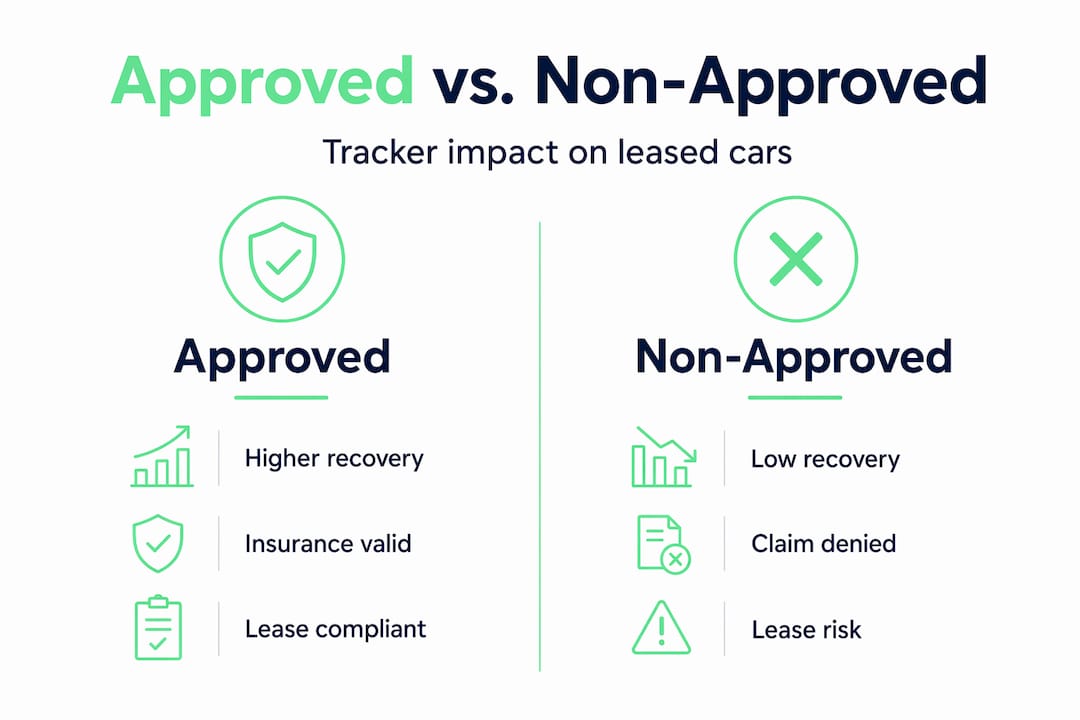
Beyond the lease contract, there is the insurance dimension. Many insurers will not recognise a tracker that lacks Thatcham certification. If your vehicle is stolen and the tracker fitted does not appear on your insurer’s approved schedule, the claim can be denied outright. This is not a technicality buried in small print. It is a standard clause in many UK motor policies, particularly for higher-value vehicles.
Here is what the approval process actually requires from a tracker:
- The device must pass independent testing by Thatcham Research covering signal reliability, tamper resistance, and police network compatibility.
- It must communicate with police search equipment fitted in patrol cars and helicopters across all UK forces.
- Installation must be carried out by a certified engineer, not self-fitted, to meet both lease and insurer conditions.
- The tracker must be registered and active on a monitored network, not simply plugged in and left dormant.
Pro Tip: Before signing any lease agreement, ask the lessor directly whether a tracker is required and which approval category they accept. Get the answer in writing. This single step prevents the majority of compliance problems at lease return.
Non-approved or self-fitted trackers carry a specific risk that many drivers do not anticipate: insurance claims being denied. The insurer’s schedule lists specific Thatcham or equivalent approved models. If your device is not on that list, the coverage gap is real.
Recovery rates and insurance benefits
The practical case for GPS tracking on a leased vehicle is straightforward when you look at the numbers. Only 13% of stolen vehicles without trackers were recovered between 2022 and 2025. With approved trackers in place, UK police recovered vehicles worth over £41.3m in 2025 alone. That gap is not marginal. It represents the operational difference between a device that communicates directly with police search equipment and one that does not.

| Scenario | Recovery likelihood | Insurance outcome |
|---|---|---|
| No tracker fitted | Very low (approx. 13%) | Standard theft claim, no premium benefit |
| Non-approved tracker fitted | Low, insurer may not recognise device | Possible claim denial, no premium reduction |
| Thatcham-approved tracker fitted | Significantly higher | Claim supported, potential premium reduction |
Thatcham-approved trackers are formally supported by all UK police forces. The system works because the tracker’s signal is picked up by equipment already installed in patrol vehicles and helicopters, allowing officers to locate a stolen car without relying on the driver to report a GPS coordinate manually. Speed matters in theft recovery, and this integration delivers it.
From an insurance perspective, the benefits of leased car trackers extend beyond recovery. Insurers use Thatcham ratings to assess the theft risk profile of a vehicle. A car fitted with a certified device presents a lower risk, and many policies reflect this with reduced premiums or, in some cases, a requirement that the device be fitted before cover is granted at all. For leased vehicles on higher-value models, this requirement is increasingly standard rather than optional.
What makes a tracker “approved” in practical terms comes down to three things: independent certification by Thatcham Research, compatibility with the national police network, and professional installation by a certified engineer. A device bought online and self-fitted, regardless of its technical specification, will not meet these criteria.
Legal and privacy considerations
Installing a tracker on a leased vehicle raises questions that go beyond the lease contract. UK data protection law applies directly to vehicle tracking, and both lessors and lessees need to understand their obligations.
Data collected by vehicle trackers is subject to UK data protection legislation. Any organisation monitoring a driver’s location must inform the driver that monitoring is taking place, specify what data is collected and how long it is retained, and secure that data against unauthorised access. This applies whether the tracker is fitted by the leasing company or by the lessee themselves.
The key obligations in practice are:
- Drivers must be informed if a tracking device is active in the vehicle they are using.
- Data must not be used for purposes beyond those disclosed at the point of consent.
- Personal location data must be stored securely and deleted when no longer needed.
- Where a lessee installs their own tracker, they take on responsibility for compliance with these rules.
The Motability Drive Smart scheme is a useful reference point here. It demonstrated both the cost management benefits of telematics and the genuine concerns that arise when drivers feel insufficiently informed about what data is being collected and why. The lesson for any lessee is clear: transparency is not optional.
Pro Tip: If you are a business lessee fitting trackers across a fleet, document your data protection policy before installation begins. A short written notice to drivers explaining what is tracked, why, and for how long will satisfy most compliance requirements and prevent disputes later.
Choosing and installing the right tracker
Selecting the right device for a leased vehicle is a process, not a single decision. Treat it as a chain of approvals, as outlined in tracker installation guidance: first verify the lease contract, then match the tracker to insurer requirements, then confirm the installer provides certified documentation.
Here is a practical sequence to follow:
- Read your lease agreement in full. Look for clauses covering modifications, tracker installation, and approved device lists. If the language is ambiguous, contact the lessor directly and request written clarification.
- Our S7 provides monitored location tracking and recovery support. S5 adds Automatic Driver Recognition using a driver tag; recognition alone does not prevent starting. Our standard S5 Plus adds tag-operated No Tag, No Start immobilisation. S5 Plus is a package description, not a separate Thatcham certification category. Confirm the exact device and installation requirements with your insurer.
- Obtain written consent from the lessor. Even where the lease permits tracker installation, written consent protects you at return. Keep this document with your lease paperwork.
- Select a certified installer. Professional installation using reversible methods is critical. Heavy financial penalties apply for permanent damage caused by poor installation, and a non-reversible fit can trigger charges at lease return even if the vehicle is otherwise in good condition.
- Register the device and activate monitoring. A tracker that is not registered on an active monitoring network provides no recovery benefit. Confirm activation with the provider before the vehicle goes on the road.
- Budget for ongoing subscription costs. Most approved trackers require an annual or monthly monitoring fee. Factor this into your total lease cost from the outset.
- Book removal before lease end. Tracker removal should be planned and booked well in advance of the return date. Professional removal leaves no trace or damage, satisfying lease return conditions.
Misconceptions that put drivers at risk
A number of common misunderstandings lead drivers into avoidable problems with leased vehicle trackers. Most of them come down to underestimating how specific the requirements actually are.
- Any tracker will do. This is the most costly misconception. A device without Thatcham certification will not satisfy most insurers and may not be accepted by the lessor. The approval status of the device is what matters, not its price or brand recognition.
- Self-installation is acceptable. It is not. Lease agreements and insurer policies both typically require professional installation by a certified engineer. Self-fitting voids the approval status of the device in most cases.
- The lessor handles everything. Some leasing companies do include trackers as part of the agreement, but many do not. Assuming the vehicle already has a compliant device fitted is a risk not worth taking. Verify before you drive.
- Privacy rules only apply to employers. Any party monitoring a driver’s location, including a lessee who fits their own tracker, is subject to UK data protection obligations. Failing to inform the driver is a compliance failure regardless of who owns the vehicle.
- Removal can be left until the return day. Booking a professional removal at the last minute is unreliable. Schedule it at least two to four weeks before the return date to avoid rushed work and potential damage charges.
My view on approved trackers for leased cars
I have seen the same situation play out more times than I would like. A driver returns a leased vehicle, confident everything is in order, and then receives a bill for tracker removal damage or, worse, discovers their theft claim has been denied because the device they fitted was not on the insurer’s approved list. Both outcomes were entirely preventable.
What I have found is that most lessees do not dismiss tracker requirements out of carelessness. They simply do not know the requirements exist until something goes wrong. The approval process, the insurer schedule, the consent requirement from the lessor, these are not widely publicised at the point of signing. That gap in communication is where problems start.
My honest advice is this: treat the tracker decision with the same seriousness as the insurance itself. Verify the lease terms, match the device to your insurer’s schedule, use a certified installer, and document every step. The cost of getting it right is modest. The cost of getting it wrong, a denied claim or a lease penalty, is not.
— Thatcham
Trackers that meet lease and insurance requirements
If you are ready to fit a compliant device, Thatchamtrackers offers a range of insurance-approved trackers certified by Thatcham Research and accepted by UK insurers. Every device in the range is supported by all UK police forces, professionally installed, and registered on an active monitoring network.
Whether your insurer requires an S5 or S7 category device, or you want guidance on choosing the right tracker for your specific lease and policy, Thatcham Trackers provides clear, straightforward options. Rated 4.8 out of 5 on both Trustpilot and Google Reviews, the service is trusted by drivers across the UK. Contact the team directly to confirm which device matches your lease and insurer requirements before installation.
FAQ
Do all lease agreements require a tracker?
Not all lease agreements require a tracker, but many do, particularly for higher-value vehicles. Always check your specific lease contract and contact the lessor directly to confirm requirements before arranging installation.
What happens if I fit a non-approved tracker on a leased car?
Fitting a non-approved tracker can result in your insurer denying a theft claim and may breach your lease agreement, leading to financial penalties at return. Only Thatcham-certified devices satisfy most UK insurer and lessor requirements.
What is the difference between S5 and S7 trackers?
Our S7 provides monitored location tracking and recovery support. S5 adds Automatic Driver Recognition using a driver tag; recognition alone does not prevent starting. Our standard S5 Plus adds tag-operated No Tag, No Start immobilisation. S5 Plus is a package description, not a separate Thatcham certification category. Confirm the exact device and installation requirements with your insurer.
Can I remove a tracker before returning a leased car?
Yes, and you should. Tracker removal must be planned and carried out by a professional engineer before the lease return date to avoid damage charges and confirm the vehicle is returned in the required condition.
Does UK data protection law apply to vehicle trackers?
Yes. Any party monitoring a driver’s location through a vehicle tracker must inform the driver, specify the purpose, and secure the data in line with UK data protection legislation. This applies to both lessors and lessees who fit their own devices.
Recommended
- Thatcham-Approved Trackers – Thatcham Trackers
- Thatcham Trackers
- Thatcham Approved S7 – Thatcham Trackers
- Thatcham Approved S5 – Thatcham Trackers