

Trackers evade interference through layered signal architecture: combining multi-constellation GNSS with GSM, VHF radio, inertial sensors, and server-side analytics so that no single point of failure can silence the device. When GPS is jammed, the system falls back to GSM cell-ID positioning; when GSM is disrupted, VHF or mesh radio takes over; when all radio contact is lost, an onboard inertial measurement unit (IMU) continues dead-reckoning until a signal is restored. Understanding GPS vehicle tracking fundamentals makes this layered logic clearer.
The six most effective defences to implement now:
- Choose a tracker with multi-constellation GNSS (GPS, GLONASS, Galileo, BeiDou) to reduce single-frequency vulnerability.
- Specify a device with VHF or alternative radio alongside GSM, so a second frequency rail operates independently.
- Confirm IMU/dead-reckoning capability to maintain position data during GNSS blackouts.
- Use a hardwired, concealed installation with tamper detection and a dedicated power feed.
- Activate server-side heartbeat monitoring and geofence alerts so gaps trigger an immediate response.
- Select a Thatcham Research-certified device; insurers recognise these approvals and they reflect independently verified anti-jamming resilience.
Legal callout: Unauthorised jamming is an offence under the Wireless Telegraphy Act 2006. Authorised GPS jamming exercises, coordinated by the Ministry of Defence and the Defence Electromagnetic Authority (DEMA), are notified to civilian users via NOTAM and CAA Skywise alerts.
Table of Contents
- How do you recognise jamming or interference on a device and server?
- What physical measures increase a tracker’s resilience to interference?
- How do server-side systems detect and respond to interference automatically?
- What operational practices reduce the risk of successful jamming?
- What is legal in the UK regarding GPS jamming, and how should owners respond?
- Real-world evidence: how Thatcham-aligned features perform under jamming
- Why layered defences matter more than any single feature
- Thatcham-approved trackers built for signal resilience
- Useful sources
- FAQ
How do you recognise jamming or interference on a device and server?
Early detection separates a recoverable incident from a cold trail. Interference leaves distinct signatures at both the device and the server.
Device-level indicators
- Sudden, complete loss of GNSS fix with no corresponding loss of GSM connectivity.
- Repeated zero-speed reports while the vehicle is clearly in motion (dead position with live accelerometer data).
- Rapid or repeated antenna tamper alerts, which can indicate physical interference with the antenna cable or an attempt to shield the device.
- Anomalous RSSI (received signal strength indicator) readings: a sharp drop in C/N0 across all visible satellites simultaneously points to a broadband noise source rather than a satellite geometry problem.
Server-level indicators
- Missing heartbeat packets during a journey, particularly when the gap aligns with a known theft or movement event.
- Unexplained gaps in trip history, especially when the vehicle’s ignition state shows active.
- Inconsistent speed or heading telemetry: a vehicle that appears to teleport between two positions, or shows heading reversals at motorway speed, suggests corrupted fix data rather than genuine movement.
- Clustering of outages at the same geographic location across multiple vehicles, which points to a fixed interference source rather than a device fault.
Quick field checklist
- Check the device’s LED status or companion app for fix-loss indicators.
- Verify antenna cable continuity and connector seating.
- Confirm the device is receiving power from the wired feed, not a backup battery alone.
- Cross-reference the outage timestamp against CAA Skywise or NOTAM records for the area.
- Test GSM connectivity independently: if GSM is live but GNSS is absent, jamming is the more likely cause than a hardware fault.
Pro Tip: Before raising a fault ticket, check the NATS AIC on RF jamming and CAA Skywise for active NOTAM notifications in the affected area. An authorised MoD exercise can produce exactly the same device symptoms as criminal jamming, and distinguishing between the two early prevents wasted response effort.
What physical measures increase a tracker’s resilience to interference?
Hardware choices made at the point of purchase and installation determine how much resilience a tracker has before any software mitigation is applied.
Multi-radio architecture
The single most effective hardware defence is separating the tracking system across multiple frequency rails. A device that combines GNSS with GSM cellular and a VHF or alternative radio channel means a jammer targeting GPS L1 does not silence the GSM uplink, and a cellular jammer does not affect the VHF channel. Anti-jamming tracker technology explains how this architecture works in practice. The documented recovery of a stolen Toyota RAV4 despite four active GPS jammers demonstrates this directly: the tracker’s VHF and mesh radio capability continued to report position when GNSS was entirely suppressed.
Antenna placement and diversity
- External antennas with a proper ground plane outperform internal patch antennas in signal acquisition, particularly in urban canyons.
- Angle-of-arrival discrimination, available in controlled-reception-pattern antennas (CRPAs), rejects signals arriving from below the horizon, which is where jammer signals typically originate.
- High-quality, shielded coaxial cable between the antenna and receiver reduces conducted interference from the vehicle’s own electronics.
- Placing the antenna away from the vehicle’s metalwork and clear of the dashboard reduces multipath and near-field noise.
Inertial sensor fusion and dead-reckoning
A MEMS IMU integrated into the tracker measures acceleration and rotation continuously. When GNSS lock is lost, the device applies dead-reckoning: it uses the last known position, speed, and heading from the IMU to project forward in time, maintaining a plausible position estimate until GNSS is restored. Kalman filtering blends the IMU data with GNSS fixes when both are available, weighting each source by its current reliability. This means a brief jamming event, lasting seconds to a few minutes, produces no gap in the position record.
Tamper and power design
Pro Tip: A hardwired, concealed installation with a dedicated fused feed is significantly harder to defeat than a plug-in OBD device. Thieves who know to deploy a jammer often also know to check obvious ports. Tracker placement guidance covers concealment best practice in detail.
- Wired power feeds prevent battery depletion attacks.
- Tamper detection circuits alert the monitoring centre if the device is moved, disconnected, or shielded.
- Concealed installation removes the visual cue that a tracker is present.
Thatcham Research certification: what to look for
Thatcham Research independently tests and certifies vehicle security devices. The S5 and S7 approval categories require devices to demonstrate reliable communication and recovery capability, and insurers use these ratings to assess theft risk. When selecting a device, confirm:
- The device holds a current Thatcham S5, S5+, or S7 certificate.
- The certificate is accepted by your insurer (request written confirmation).
- The installer is approved to fit the specific device category.
- The device supports firmware updates so the manufacturer can respond to new jamming techniques.
How do server-side systems detect and respond to interference automatically?
Hardware resilience buys time. Server-side analytics convert that time into a coordinated response.
Heartbeat and watchdog patterns
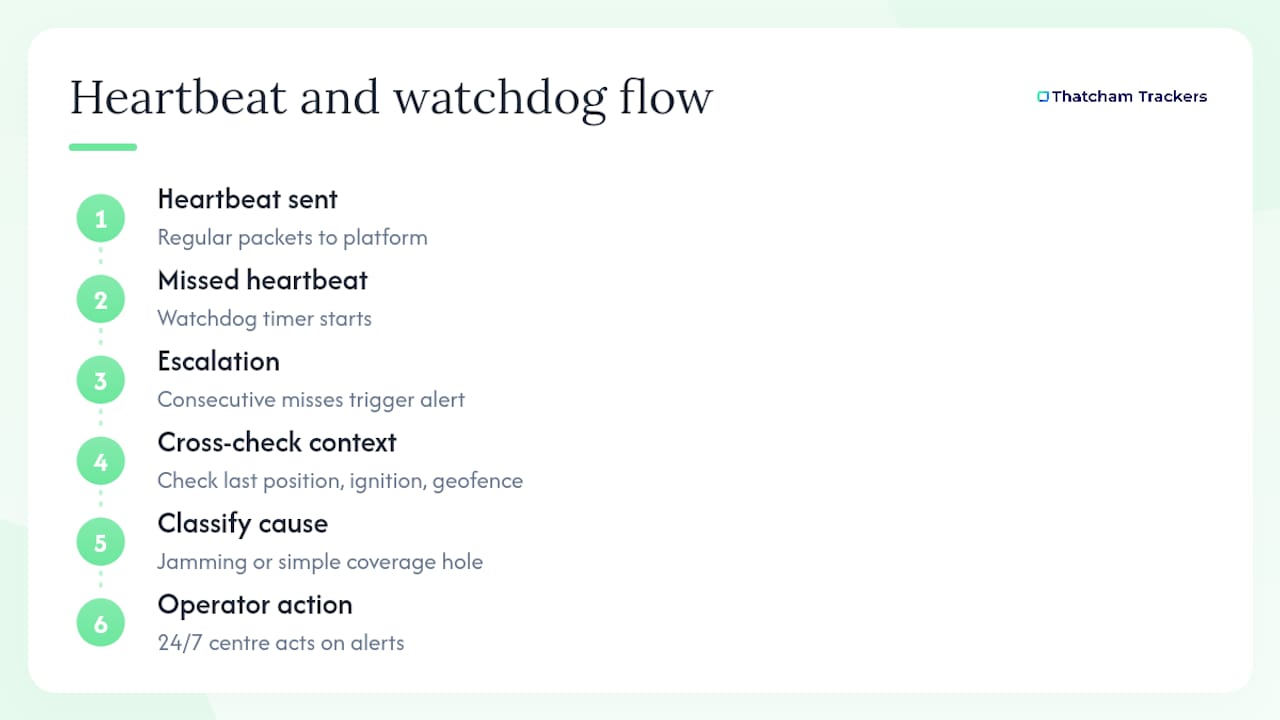
Every certified tracker sends regular heartbeat packets to the monitoring platform. A missed heartbeat triggers a watchdog timer; consecutive missed packets escalate to an alert. The platform cross-references the last known position, the vehicle’s ignition state, and any geofence boundaries to assess whether the gap is consistent with jamming or a simple coverage hole. Vehicle tracking response centre capabilities explain how 24/7 operators act on these alerts.
Anomaly detection on fix density and SNR
Server analytics can flag:
- A sudden drop in the number of visible satellites reported by the device.
- C/N0 values falling below a configurable threshold across all channels simultaneously.
- Fix density dropping from one position per second to zero without a corresponding ignition-off event.
- Speed or heading values that are physically implausible given the previous fix.
Adaptive filtering and Kalman fusion on the server
When the server receives IMU dead-reckoning data alongside degraded GNSS fixes, a server-side Kalman filter can weight the two sources dynamically. During active jamming, the filter increases the weight on IMU-derived position and reduces reliance on the corrupted GNSS fix, producing a smoothed track rather than a gap or a wild excursion. Once GNSS quality recovers, the filter rebalances automatically.
Example alert workflow
- Device misses two consecutive heartbeat packets.
- Platform checks ignition state: ignition on, last fix 4 minutes ago, vehicle inside a geofence.
- Platform escalates to operator with last known position, device ID, and C/N0 history.
- Operator attempts GSM contact with the driver; no response triggers police notification with forensic log.
- If the device supports remote immobilisation and the vehicle is confirmed stolen, immobilisation command is issued.
- Forensic log (timestamps, fix history, SNR data, heartbeat gaps) is packaged for police and insurer.
Pro Tip: Reduce false positives by setting heartbeat alert thresholds to three or more missed packets rather than one. Single-packet gaps occur legitimately in areas of poor GSM coverage; three consecutive gaps are a much stronger indicator of active interference or device removal.
What operational practices reduce the risk of successful jamming?
Technology alone does not close every gap. Operational discipline significantly reduces the probability that a jammer will succeed.
Installation and concealment
- Use an approved installer for the specific Thatcham category; unapproved installations can void the certificate and the insurance benefit.
- Specify a hardwired installation rather than an OBD plug-in wherever possible.
- Avoid predictable locations such as the OBD port, the driver’s footwell, or under the front seats; these are the first places a knowledgeable thief checks.
- Rotate parking locations for high-value vehicles; a vehicle parked in the same spot nightly is easier to survey and target.
Driver and fleet manager training
- Drivers should know the monitoring centre’s contact number and report any loss of tracking confirmation immediately.
- If tracking is lost during a journey, drivers should move to a populated, well-lit area and contact the monitoring centre before stopping.
- Fleet managers should review trip history gaps daily, not weekly; a 24-hour review cycle means a theft event is caught within one working day.
- Maintain an audit trail of scheduled location checks so unexplained absences are identified quickly.
Incident contact flow
When jamming or theft is suspected, the recommended contact order is:
- Monitoring centre (they hold the forensic log and can coordinate with police directly).
- Police (999 for an active theft; 101 for a report after the fact).
- Ofcom (for suspected criminal jamming; they enforce the Wireless Telegraphy Act).
- Insurer (notify as soon as possible; provide the device certificate number and the monitoring centre’s incident reference).
Pro Tip: Keep a printed record of the monitoring centre’s number in the vehicle and with the fleet manager. If a thief jams GSM as well as GPS, the driver’s mobile may also be affected, making a stored contact number the fastest route to help.
What is legal in the UK regarding GPS jamming, and how should owners respond?
Unauthorised operation of a GPS jammer is an offence under Section 68 of the Wireless Telegraphy Act 2006. Ofcom enforces this and cannot itself authorise jammers; only Crown authority or specific legislative provision permits lawful jamming. Penalties include unlimited fines and confiscation of equipment.
Reporting contacts and evidence to collect
When criminal jamming is suspected, collect and preserve:
- Device logs with timestamps of fix loss and heartbeat gaps.
- Last known GPS coordinates before the outage.
- GSM connectivity status during the same period.
- Screenshots of the trip history gap from the monitoring platform.
- Any dashcam footage covering the period.
Report to police with the above evidence. Report suspected criminal jamming separately to Ofcom via their online interference reporting tool. Notify the insurer with the device certificate number and the monitoring centre’s incident reference.
Pro Tip: Check Skywise and the NOTAM AIS portal before concluding that a fix loss is criminal. Authorised exercises in the UK can produce widespread GNSS outages that affect dozens of vehicles simultaneously. If multiple fleet vehicles lose GNSS at the same time in the same region, an authorised exercise is the more likely explanation.
Real-world evidence: how Thatcham-aligned features perform under jamming
When four GPS jammers were deployed against a stolen Toyota RAV4, the vehicle’s multi-radio tracker continued to report position via VHF and mesh network. Police recovered the vehicle and arrested a suspect promptly following the report of theft. GPS-only systems would have gone dark at the moment the jammers were activated.
This documented UK recovery illustrates the core principle: layered radio architecture means a jammer targeting one frequency rail does not silence the device. The same principle applies to maritime operations, where Admiralty guidance recommends cross-checking GNSS position against dead reckoning, RADAR overlays, and secondary position sensors whenever interference is suspected.
What Thatcham Research certification means for anti-jamming resilience
Thatcham Research independently tests vehicle security devices against defined performance criteria. S5 and S7 approvals require demonstrated communication reliability and recovery capability. Insurers use these ratings to assess theft risk and often require or reward certified devices with lower premiums. Certification is not a marketing claim; it reflects a device’s performance under controlled test conditions.
Questions to ask an installer or vendor
- Which Thatcham category does the device hold, and is the certificate current?
- Does the device use multi-constellation GNSS, and which constellations are supported?
- Is there a VHF or alternative radio channel independent of the GSM uplink?
- Does the device include an IMU for dead-reckoning during GNSS outages?
- How are firmware updates delivered, and how quickly does the manufacturer respond to new jamming techniques?
- Is the installation method approved for the specific device category, and will it be accepted by my insurer?
Why layered defences matter more than any single feature
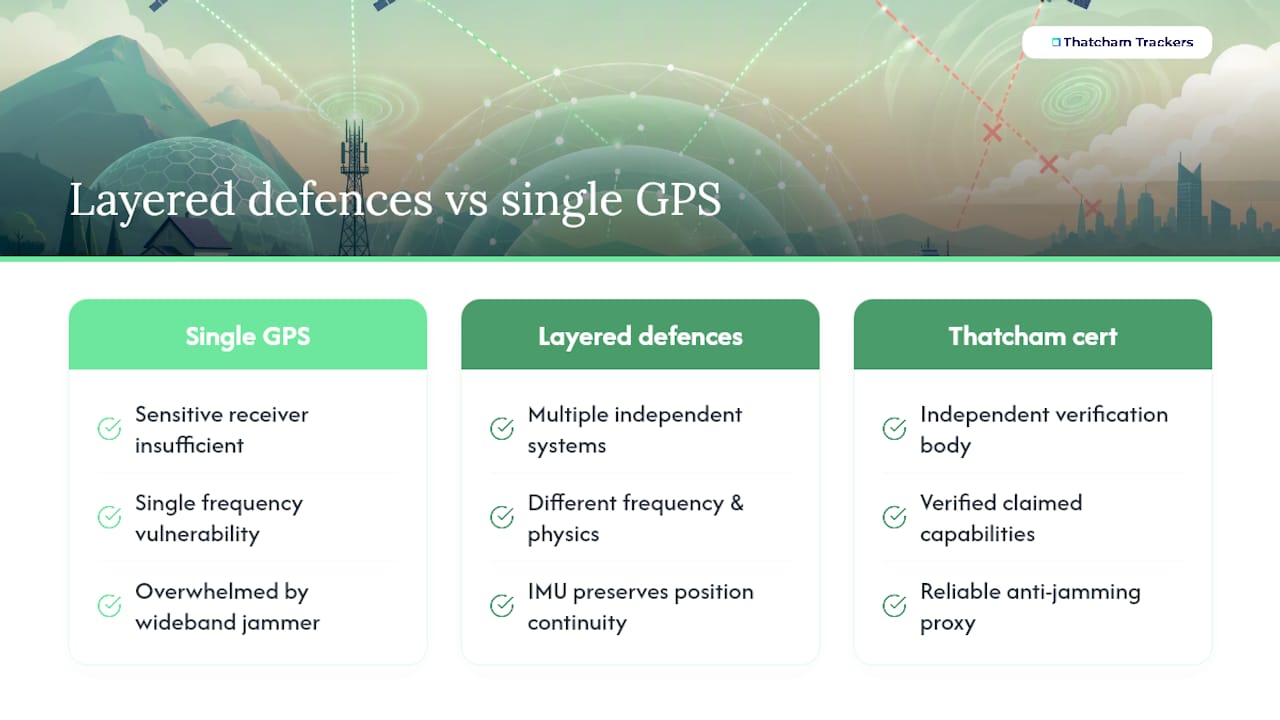
The conventional view in vehicle security is that a better GPS chip solves the jamming problem. It does not. A more sensitive receiver is still a single point of failure on a single frequency band, and a wideband jammer overwhelms it just as effectively as it overwhelms a cheaper one. The real protection comes from making the attacker defeat multiple independent systems simultaneously, each operating on a different frequency and a different physical principle.
The IMU dead-reckoning point is consistently underestimated. Most owners focus on radio resilience and overlook the fact that a 90-second GNSS blackout, which is enough time to drive a vehicle into a container or a covered compound, produces no gap in the position record when an IMU is present. That continuity of evidence is what gives police a usable trail rather than a cold start.
Thatcham Research certification matters for a reason beyond insurance premiums. The independent test process means the device’s claimed capabilities have been verified by a body with no commercial interest in the outcome. For owners and fleet managers selecting a tracker, that certification is the most reliable proxy for genuine anti-jamming performance available in the UK market.
Thatcham-approved trackers built for signal resilience
Interference-resistant tracking is not a premium add-on. It is the baseline that Thatcham Research certification requires. Thatcham Trackers supplies Thatcham-approved S7, S5 Plus, and S5 devices, each with multi-radio capability, tamper detection, and 24/7 monitoring compatibility. Every device comes with a mandatory digital certificate accepted by UK insurers, and nationwide mobile installation is available so the device is fitted correctly by an approved technician.

For owners who need immobilisation alongside tracking, the Ghost Immobilisation range adds a further layer of protection that operates independently of the GNSS signal entirely. View the full Thatcham-approved tracker range or contact Thatcham Trackers directly to confirm which device and approval level your insurer requires before ordering.
Useful sources
The following authoritative sources support the technical, legal, and operational content in this article.
| Source | Relevance |
|---|---|
| Ofcom: GPS jamming exercises | UK legal baseline; Wireless Telegraphy Act enforcement; DEMA authorisation process. |
| NATS AIC 046/2023: RF Jamming in the UK | NOTAM/Skywise notification procedures; multi-constellation impact; CAA impact estimation guidance. |
| AM-online: Four GPS jammers fail, RAV4 recovered | Documented UK recovery demonstrating multi-radio and mesh resilience against active jammers. |
| Admiralty: Jamming and spoofing | Detection methods, dead reckoning, and secondary sensor cross-checks; maritime context with direct application to vehicle tracking. |
| ResearchGate: Analysis of interference effect on GPS receiver | Technical analysis of wideband vs narrowband jamming effects on acquisition and tracking performance. |
| GPS World: A day without satellites | Industry context on systemic GNSS reliance and the broader consequences of signal impairment. |
FAQ
Does aluminium foil block a GPS tracker signal?
Wrapping a tracker in aluminium foil can attenuate GNSS signals, but a multi-radio device with VHF or GSM capability will continue to report position via those alternative channels. Complete signal isolation requires a purpose-built Faraday enclosure, not foil.
Can a magnet disable a GPS tracker?
A standard magnet cannot disable a GPS tracker. Modern tracker electronics are not affected by magnetic fields at the strengths a handheld magnet produces; the risk from magnets is negligible compared to active jamming.
What can interfere with a GPS signal?
GPS signals are disrupted by deliberate jammers broadcasting on L-band frequencies, by wideband radio noise from industrial equipment, by multipath reflections in urban environments, and by severe atmospheric conditions. Authorised MoD exercises can also produce temporary civilian GPS loss across a defined area.
How are signal jammers tracked and detected?
Jammers are detected through anomaly patterns on monitoring platforms: simultaneous fix loss across multiple devices in the same area, C/N0 drops across all satellite channels, and heartbeat gaps correlated with vehicle movement. Ofcom uses direction-finding equipment to locate illegal transmitters, and reports from fleet operators and individuals assist that enforcement process.
Which tracker features best resist jamming in the UK?
Thatcham-approved devices with multi-constellation GNSS, an independent VHF or GSM radio channel, an onboard IMU for dead-reckoning, and 24/7 server-side heartbeat monitoring offer the strongest combination of interference evasion techniques available to UK vehicle owners.