

A Thatcham-recognised tracker fitted by a certified mobile engineer is the fastest, most reliable way to meet your insurer’s requirements and protect your vehicle. To book one locally, follow three steps: confirm which Thatcham category your insurer requires, select an accredited fitter who issues a digital installation certificate, and verify that the device pairs with a 24/7 Secure Operating Centre (SOC).
Before you book, confirm these four points:
- Thatcham category required: S7 (entry-level GPS recovery), S5 (GPS plus driver ID), or S5+ (GPS, driver ID, and automatic immobilisation)
- Accredited fitter: the engineer must hold recognised installer accreditation; the device is only insurance-approved when fitted by a qualified technician
- SOC/monitoring: your policy may require continuous 24/7 monitoring, not just the hardware
- Digital installation certificate: insurers ask for this document at renewal or after a theft claim; without it, the tracker may not be accepted
Table of Contents
- Why does professional installation matter for insurance and theft recovery?
- What does a professional installation appointment look like?
- What does professional tracker installation cost?
- Where do installers fit trackers, and what should you ask them?
- How do Thatcham approval and insurer rules affect your choice of installer?
- Why certified installation is the only route worth taking
- Book a certified local installation with Thatcham Trackers
- Useful sources and further reading
- FAQ
Why does professional installation matter for insurance and theft recovery?
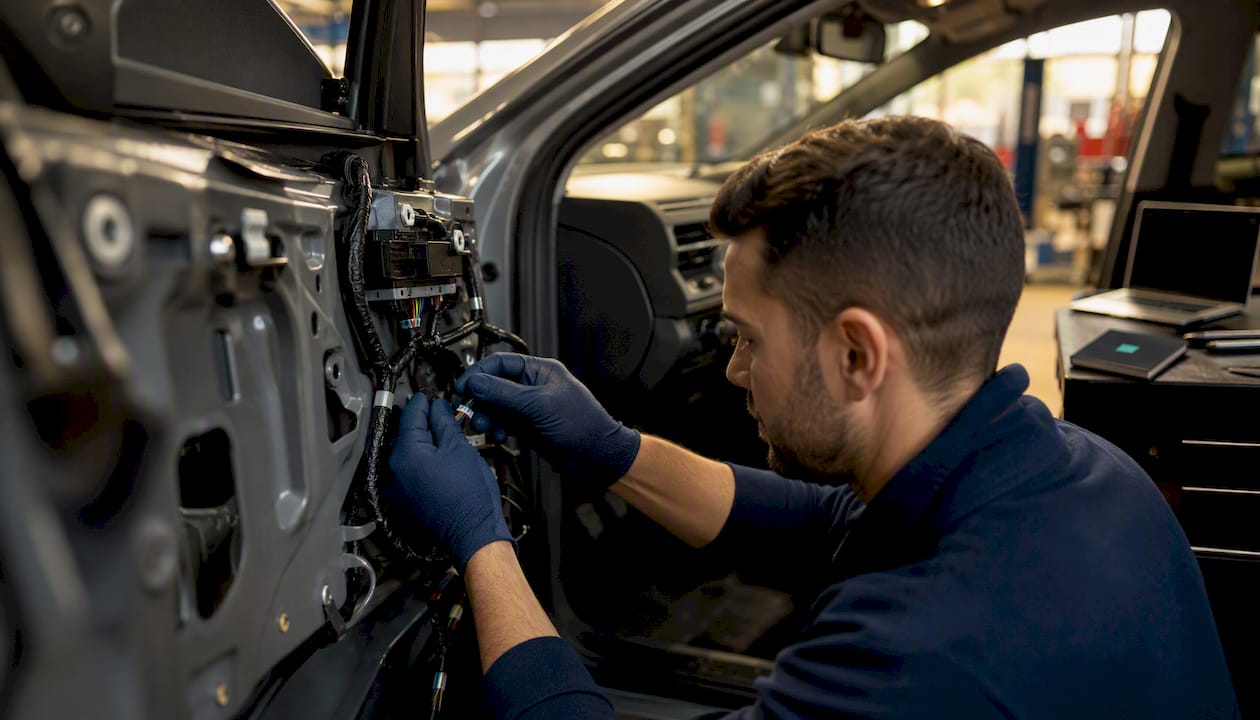
A professionally fitted, insurance-approved tracker is not simply a device plugged into the OBD port. Thatcham Research certifies both the hardware and the installation standard: the unit must be hardwired into the vehicle’s wiring loom, concealed from view, and non-tamperable. That combination is what allows insurers to accept it as meeting policy conditions and what gives police recovery teams a reliable signal to work with.
A plug-in device may satisfy a black-box telematics policy, but it will not satisfy a theft-recovery requirement. Insurers typically ask for an installation certificate before applying a premium discount or confirming that the tracker meets cover conditions. The certificate is only issued after a qualified, accredited engineer completes the fit.
Key benefits of certified professional installation:
- Insurance compliance: device and fit both meet Thatcham and insurer standards
- Tamper resistance: hardwired concealment makes removal difficult without triggering an alert
- Concealed wiring: no visible cables that indicate the tracker’s location to a thief
- Activation and testing: the engineer confirms GPS lock, SOC pairing, and tamper alerts before leaving
- Digital certificate: issued on completion and accepted by UK insurers
- SOC compatibility: the device is registered with a monitoring centre for 24/7 response
Pro Tip: Ask your insurer for their exact wording in writing before you buy. Some policies specify a Thatcham category (S5, S7); others simply require a “Thatcham-recognised device and accredited fitter.” The difference can affect which product you need and whether monitoring is mandatory.
What does a professional installation appointment look like?
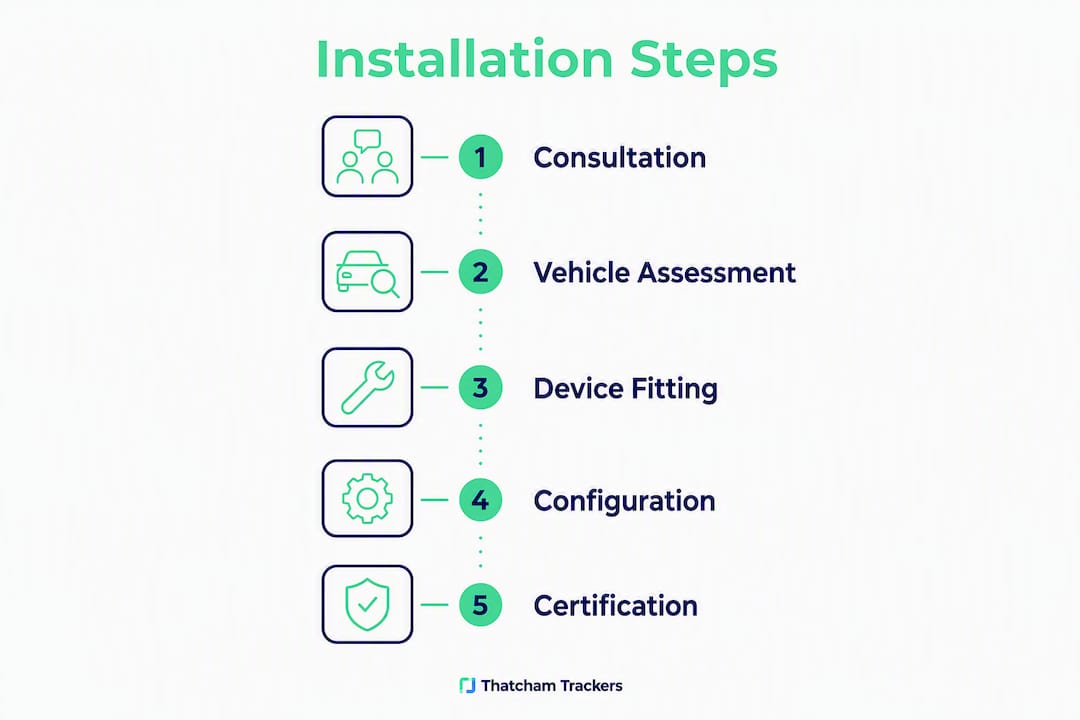
A typical professional installation is a hardwired, concealed fitting carried out by an accredited engineer. Most appointments take approximately 1–2.5 hours, depending on vehicle type and how complex the concealment needs to be. Mobile visits at your home, workplace, or storage site are standard practice.
- Pre-booking questions: the installer asks for your vehicle make, model, year, and VIN, plus your insurer’s category requirement
- Arrival and ID checks: the engineer confirms your identity and vehicle ownership before starting work
- Vehicle inspection: a brief check of the wiring loom access points, battery location, and any previous security hardware
- Hardwiring and concealment: the unit is wired directly to a permanent power source and hidden within the vehicle’s structure, away from obvious access points
- Activation and SOC pairing: the engineer registers the device with the monitoring centre and confirms a live GPS fix
- Diagnostic tests: tamper alerts, GPS accuracy, and SOC communication are all verified before sign-off
- Paperwork and digital certificate: the installer issues the digital installation certificate, which you forward to your insurer
Timeline by vehicle type:
- Standard car: 1–1.5 hours
- Van or 4x4: 1.5–2 hours
- Motorhome or stored vehicle: up to 2.5 hours
Documents to have ready for a mobile fit:
- Proof of vehicle ownership (V5C logbook)
- Your insurance policy wording if the engineer needs to confirm the required category
- Parking or storage address and any access instructions
Pro Tip: For stored vehicles such as motorhomes or show cars, confirm in advance that the installer can attend the storage site and will issue the same digital certificate there. Not all mobile engineers cover every postcode.
What does professional tracker installation cost?

Total cost has three components: tracker hardware, the professional fitting fee, and ongoing monitoring or subscription. S7 hardware is generally priced starting around the lower hundreds of pounds, with S5 models generally priced higher and requiring a more involved installation. Monitoring adds a recurring monthly or annual fee on top.
Typical price bands (hardware and fitting combined):
- S7 entry-level device: hardware from the lower hundreds of pounds; fitting fees vary by installer and location
- S5 mid-range device: higher hardware cost; fitting is more involved due to driver ID components
- S5+ advanced device: highest hardware cost; includes automatic immobilisation wiring
- Mobile visit premium: some installers charge a call-out fee for home or workplace visits
- Monitoring/subscription: a monthly or annual fee for 24/7 SOC access, required by most insurers
- Warranty and post-fit support: included by reputable installers; confirm the duration before booking
Cost drivers include the Thatcham category, vehicle type, concealment difficulty, distance for the mobile visit, and whether immobilisation or battery backup is included. Breaking down a quote by hardware, fitting, monitoring, and warranty before you agree to anything is the clearest way to compare installers accurately.
Pro Tip: Supply your vehicle VIN, parking or storage location, and your insurer’s written requirements when requesting a quote. Ask for a full written itemisation covering hardware, labour, monitoring, and warranty. A quote that bundles everything into one figure is harder to compare and easier to inflate.
Where do installers fit trackers, and what should you ask them?
Installers conceal units within the wiring loom, under the dashboard, inside wheel arches, behind interior trim, or in the engine bay. The exact location depends on the vehicle model, GPS signal quality at each point, available power routing, and how well the position resists tampering. Common covert locations include the undercarriage, inside wheel arches, behind trim panels, and near the fuse box.
Typical fitting locations and the reason each is chosen:
- Under the dashboard: direct access to wiring loom and permanent power; well concealed behind trim
- Wheel arches: good GPS signal, difficult to access without tools
- Behind interior trim panels: hidden from casual inspection; power routed through existing loom
- Engine bay: accessible power source; requires weatherproofing
- Near the fuse box: clean power connection; compact units fit without modification
The location is never disclosed to the vehicle owner in writing for security reasons, but a reputable installer will confirm the general area verbally.
Questions to ask your installer before and during the appointment:
- What is your installer accreditation, and can you show documentation?
- Which Thatcham category does this device carry, and does it match my insurer’s requirement?
- Which SOC will the device be registered with, and is monitoring included or a separate subscription?
- What warranty covers the hardware and the installation?
- Will you issue a digital installation certificate on the day?
- Does this device include automatic immobilisation, and how is it activated?
- Is battery backup included, and how long does it last if the vehicle’s power is cut?
- What tamper alert does the device trigger, and how is it communicated?
On data and privacy: the tracker shares live location with the SOC and, when requested, with police recovery teams. Your monitoring subscription agreement will set out who can access location data and under what circumstances.
How do Thatcham approval and insurer rules affect your choice of installer?
Insurers accept a tracker only when the device, the monitoring arrangement, and the installation all meet their policy wording. Thatcham Research runs the UK’s security certification programme and maintains a searchable database of certified products. An S7 device provides GPS recovery; S5 adds driver identification; S5+ adds automatic immobilisation. The right category depends entirely on what your insurer specifies.
The digital installation certificate is the document that ties the device, the accredited fitter, and the SOC registration together. Without it, an insurer has no way to verify that the tracker meets their conditions. Keep it with your policy documents and present it at renewal.
What a complete, insurer-accepted installation includes:
- A Thatcham-certified device in the correct category (S7, S5, or S5+)
- Hardwired, concealed installation by an accredited engineer
- SOC registration and 24/7 monitoring activation
- Digital installation certificate issued on the day
- Post-fit support and warranty from the supplier
Thatcham Trackers supplies Thatcham-approved S7, S5, and S5+ devices with nationwide accredited mobile installation, the mandatory digital certificate, and 24/7 SOC-compatible monitoring. The service covers cars, vans, motorhomes, and fleets.
Pro Tip: If your insurer’s wording is ambiguous, ask them in writing whether they require a specific Thatcham category or simply a “Thatcham-recognised device and accredited fitter.” Insurers vary on this point, and the answer determines which product you need.
Why certified installation is the only route worth taking
The temptation to save money with a self-fitted plug-in device is understandable. However, the certification process that Thatcham Research runs is not a formality. It covers the hardware, the installation method, and the SOC pairing as a single verified package. An insurer who asks for a Thatcham-approved tracker is asking for all three elements, not just the device in the box.
The digital certificate is the practical proof of that package. A vehicle stolen without one may still be recovered, but the owner faces a harder conversation with their insurer about whether the policy conditions were met. Nationwide mobile fitting, as offered by Thatcham Trackers, removes the logistical barrier that leads some owners to cut corners. The engineer comes to you, completes a verified installation, and hands over the certificate the same day.
Book a certified local installation with Thatcham Trackers
Thatcham Trackers offers a faster path to insurance compliance than sourcing hardware and an installer separately. The service combines Thatcham-approved S7, S5, and S5+ devices with nationwide accredited mobile installation, the mandatory digital certificate, and 24/7 SOC-compatible monitoring, all in a single order.
Booking is straightforward. Check your insurer’s category requirement, select the matching device from the Thatcham-approved tracker range, and book a mobile installation visit at your home, workplace, or storage site. The accredited engineer arrives, completes the hardwired concealed fit, activates SOC monitoring, and issues your digital certificate on the day. Post-fit support and warranty are included. To get started, visit thatchamtrackers.com or use the online order form to confirm your vehicle details and preferred appointment location.
Useful sources and further reading
- Thatcham Security Certifications — Thatcham Research: the official database for checking whether a device and installer hold current Thatcham certification
- Insurance Approved Vehicle Tracker: A Complete Guide — insurd: practical guidance on insurer requirements, certificate documentation, and monitoring obligations
- Car Tracker: Do I Need One and How Much Does It Cost? — Carwow: consumer-facing cost benchmarking for S7 and S5 hardware and subscription fees
- Thatcham S7 Tracker Installation Guide — Thatcham Trackers: step-by-step S7 installation requirements and paperwork explained
- Choose the Right Thatcham Tracker — Thatcham Trackers: category matching tool to align device choice with insurer requirements
FAQ
How can you locate a GPS tracker on a vehicle?
Professional installers conceal trackers in locations such as wheel arches, behind trim panels, under the dashboard, and near the fuse box. A GPS detector can identify active signals from covert devices in these areas.
How much does it cost to have a tracker fitted to your vehicle?
Total cost covers hardware, a professional fitting fee, and an ongoing monitoring subscription. S7 hardware is generally priced starting around the lower hundreds of pounds; S5 and S5+ devices cost more, with fitting and monitoring adding to the total.
Where are GPS trackers installed in a vehicle?
Accredited engineers fit trackers in concealed, hardwired locations including the wiring loom, wheel arches, behind interior trim, under the dashboard, or in the engine bay, chosen for power access, GPS signal quality, and tamper resistance.
Do I need a professional installer for an insurance-approved tracker?
Yes. A Thatcham-approved tracker is only accepted by insurers when installed by an accredited engineer who issues a digital installation certificate. A self-fitted or plug-in device will not satisfy most insurer requirements for theft recovery cover.
Recommended
- Tracker engineer installation: what it is and why it matters – Thatcham Trackers
- Car tracker professional installation benefits explained – Thatcham Trackers
- Thatcham S7 tracker installation guide for 2026 – Thatcham Trackers
- Hidden car tracker installation tips: the complete guide – Thatcham Trackers