

Movement and speed alerts from a Thatcham‑approved insurance tracker are legal in the UK when the device carries Thatcham Research certification, was professionally installed, and is used in a way that satisfies UK GDPR and your insurer’s policy conditions. The three actors that decide this are Thatcham Research, your insurer, and the Data Protection Act 2018. Before fitting anything, call your insurer to confirm which category they require, and keep your installation certificate somewhere safe.
TL;DR:
- Insurers require Thatcham-certified trackers installed professionally and accompanied by an installation certificate to ensure legality and valid theft coverage.
- The correct Thatcham category—S7, S5, or S5+—must align with your policy, with higher categories needed for higher-value or high-risk vehicles.
- Speed and movement alerts are mainly for theft recovery; continuous speed monitoring for behavior tracking is legal only when proportionate and properly disclosed.
- Employers must conduct lawful basis assessments, implement clear policies, and keep records when using trackers for fleet management to comply with UK GDPR.
- Using a non-certified or incorrectly categorized tracker can void insurance coverage during a theft claim.
Table of Contents
- UK legal framework for tracker speed alerts
- What Thatcham S7, S5 and S5+ actually mean
- When movement and speed alerts are actually used
- Employer and fleet checklist for tracker alerts
- Steps to take if your insurer requires a Thatcham tracker
- Thatcham Trackers’ view on alerts and compliance
- Fitting the right tracker without the guesswork
- Sources
- FAQ
UK legal framework for tracker speed alerts
Vehicle tracking data counts as personal data, so its use is governed by UK GDPR and the Data Protection Act 2018 rather than any bespoke “tracker law”. Whichever entity decides why and how the data gets used is the data controller under this framework, and that role carries real obligations around fairness, transparency, and proportionality.
If you own the car, motorhome, or van and fitted the tracker to satisfy an insurer, your position is usually straightforward. You are the data controller for your own vehicle. Movement alerts exist to help recover a stolen vehicle, not to police your driving, so there’s rarely a conflict between what the device does and what the law expects. Your main job is making sure any monitoring centre contract you sign is clear about who holds the data and for how long.
Employers and fleet operators face a stricter test. GPS vehicle tracking is legal for company vehicles, but staff must be told it’s happening, and the employer needs a documented lawful basis, which is commonly legitimate interest. Continuous or covert monitoring raises the bar further. According to guidance the Information Commissioner’s Office has published on workplace monitoring, there’s no single tracking statute, so the test always comes back to purpose, transparency, and proportionality.
Practical controls that keep fleets on the right side of this include:
- A written policy explaining what’s tracked, why, and for how long
- Retention limits on speed and movement logs rather than indefinite storage
- Restricted access so only relevant staff can view driver data
- A documented Data Protection Impact Assessment for continuous or covert monitoring
Pro Tip: Legitimate interest isn’t a rubber stamp. Employers still need to run and document a legitimate‑interest assessment; treating consent as an easy substitute usually creates more paperwork, not less.
What Thatcham S7, S5 and S5+ actually mean
Insurers don’t ask for “a tracker”. They ask for a specific Thatcham category, and getting this wrong is one of the more common reasons theft claims stumble. Thatcham Research tests and certifies each category, and S7 and S5 are the two current insurer‑recognised standards, with S5+ sitting above them for higher‑risk vehicles.
- S7: The baseline standard for most cars, vans, and motorhomes. It gives 24/7 monitoring and direct police liaison if the vehicle moves without authorisation.
- S5: Everything S7 offers, plus Automatic Driver Recognition (ADR), which flags when the vehicle is driven without a recognised tag or fob nearby. Insurers commonly specify S5 for high‑value vehicles because ADR helps counter relay attacks and key cloning.
- S5+: Adds remote immobilisation, letting a monitoring centre stop the vehicle being driven away once a theft is confirmed. This is the category insurers tend to demand for the vehicles they consider highest risk.
None of this matters without professional fitting. Certification is tied to Thatcham‑accredited installation, and that installation produces the certificate your insurer will ask to see. A self‑fit device, or the wrong category for your policy, can leave your theft cover void even though the hardware itself works fine.
When movement and speed alerts are actually used
Alerts generated by a Thatcham‑approved tracker fall into two distinct categories, and confusing them is where most misunderstandings about legality start.
Tamper alerts, unauthorised movement alerts, and ADR triggers exist for one purpose: theft recovery. These are the insurer‑aligned uses that monitoring centres and police liaison are built around, and they’re what your policy is actually paying for.
Continuous speed monitoring is a different function, closer to general telematics than theft protection, and it carries different legal weight because it tracks ongoing behaviour rather than a single security event.
- Private owners: theft‑recovery alerts are proportionate and expected; the tracker isn’t there to enforce speed limits on your own driving.
- Fleets: continuous behavioural monitoring, including speed data, must be proportionate to a genuine business purpose, disclosed to drivers, and properly documented.
Employer and fleet checklist for tracker alerts
Fleet managers carry heavier compliance obligations than private owners, simply because they’re processing data about other people. A short, working checklist:
- Record a lawful basis for tracking, usually legitimate interest, and complete a legitimate‑interest assessment rather than assuming the basis is self‑evident.
- Write a driving‑at‑work policy that names what’s collected, how alerts are used, and who can see them.
- Run a Data Protection Impact Assessment before enabling covert or continuous monitoring features.
- Restrict out‑of‑hours tracking technically where practical, and set clear data retention periods.
- Put processing agreements in place with your monitoring centre, covering how police‑liaison data is handled.
Guidance built specifically for commercial operators, such as taxi and private hire fleet compliance resources, can help translate these steps into day‑to‑day driver communication.
Pro Tip: Keep your DPIA and driver policy as living documents. Insurers and the ICO both respond better to evidence you review these annually than to a one‑off document signed three years ago.
Steps to take if your insurer requires a Thatcham tracker
- Call your insurer first and ask which current category they need, S7 or S5, since some policies still reference older Cat 6/Cat 7 language.
- Book a Thatcham‑accredited engineer for professional installation and keep the installation certificate that gets issued afterwards.
- Register the device with the monitoring centre and test that alerts actually fire before you rely on them.
- Keep a record of your monitoring contract, who can access your data, and how long it’s retained.
- Send your certificate to your insurer at renewal, or whenever they ask for proof the condition is met.
- Fleet operators should fold contract updates and DPIA evidence into the same renewal cycle.
Motorhome and campervan owners in particular should treat this as non‑negotiable: insurers commonly make Thatcham‑approved trackers mandatory for motorhomes given their higher values and the storage risk when they’re left off‑season.
Thatcham Trackers’ view on alerts and compliance
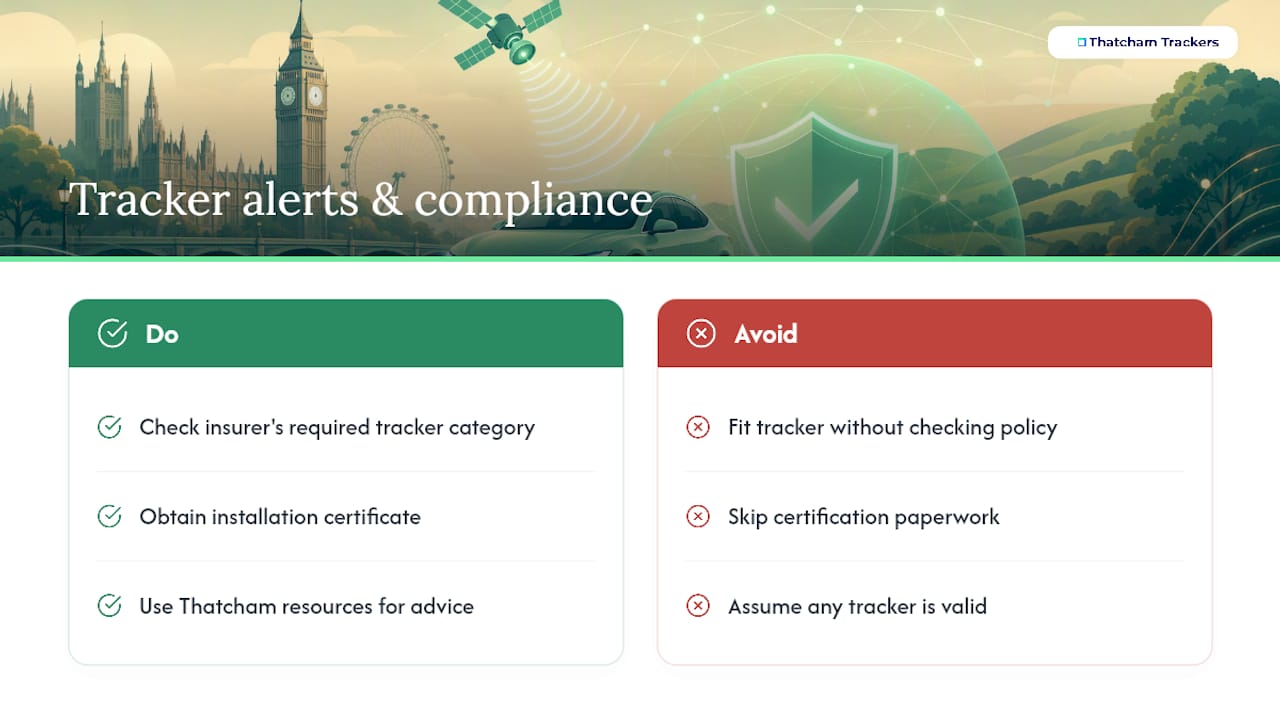
Certification and a proper installation certificate aren’t paperwork for its own sake. They’re what protects a genuine claim when a vehicle goes missing, and they’re what gives the police something concrete to act on during recovery. Too many owners fit a tracker, then discover at claim time it was the wrong category for their policy.
Confirm what your insurer actually wants before you buy anything. Thatcham Trackers’ own installation and advice resources are there for exactly that conversation.
— Thatcham Trackers
Fitting the right tracker without the guesswork
Thatcham Trackers sells S7, S5, and S5+ devices with nationwide professional fitting, so you’re never guessing whether a self‑fit box meets your insurer’s wording. Every installation carries the Thatcham‑recognised certificate insurers ask for at renewal or claim time, which means the compliance side of this is handled the moment the engineer leaves your driveway.
If your policy specifies the standard category, the S7 collection covers most cars, vans, and motorhomes. Where an insurer asks for Automatic Driver Recognition on a higher‑value vehicle, the S5 collection is the fit. For vehicles where remote immobilisation is required, the S5+ range adds that layer. Check your policy wording, then get in touch to confirm the exact category before you order, so the certificate you receive matches what your insurer actually asked for.
Sources
- Thatcham Research
- Thatcham approved trackers: S5 vs S7 (KeepClose)
- Insurance approved vehicle tracker: a complete guide | insurd®
- Vehicle tracking laws UK 2026: GDPR, ICO rules & compliance guide
This article is general information, not a substitute for advice from a qualified lawyer. Consult a qualified legal professional about your own circumstances before acting on anything here.
FAQ
Are speed alerts from a Thatcham tracker legal in the UK?
Yes, provided the device is Thatcham‑certified, professionally installed, and used in line with UK GDPR and your insurer’s stated conditions.
Do I need consent to track a company vehicle?
Not necessarily. Employers commonly rely on legitimate interest rather than consent, but they must document a legitimate‑interest assessment and tell drivers what’s being monitored.
What’s the difference between Thatcham S7 and S5?
S7 gives baseline 24/7 monitoring and police liaison for most vehicles, while S5 adds Automatic Driver Recognition for higher‑value vehicles at greater theft risk.
Can fitting the wrong tracker category invalidate my insurance?
Yes. If your policy specifies S5 and you fit S7, or you use a non‑certified device, your insurer can treat the theft cover condition as unmet.
Do motorhome owners need a Thatcham tracker?
Many insurers make it mandatory given the higher values and storage risks motorhomes carry, so it’s worth checking your policy wording directly rather than assuming.