

A car tracker alerts police by transmitting real-time GPS location data to a secure monitoring centre, which verifies the theft and coordinates directly with law enforcement to enable rapid vehicle recovery. This process is not a single button press. It is a networked chain of technology, human verification, and police protocols that together determine how quickly your vehicle is found. Understanding how car tracker alerts police works in practice gives you a clear picture of what to expect and why the quality of your tracker matters enormously.
How does a car tracker send alerts to police authorities?
The technical process behind a vehicle theft alert follows a defined sequence. GPS trackers transmit location data using cellular GPRS networks to a secure cloud platform, where the data is processed and alerts are generated based on triggers such as geofence breaches or abnormal speed patterns. That data then reaches a professional monitoring centre, which acts as the critical intermediary between your vehicle and the police.
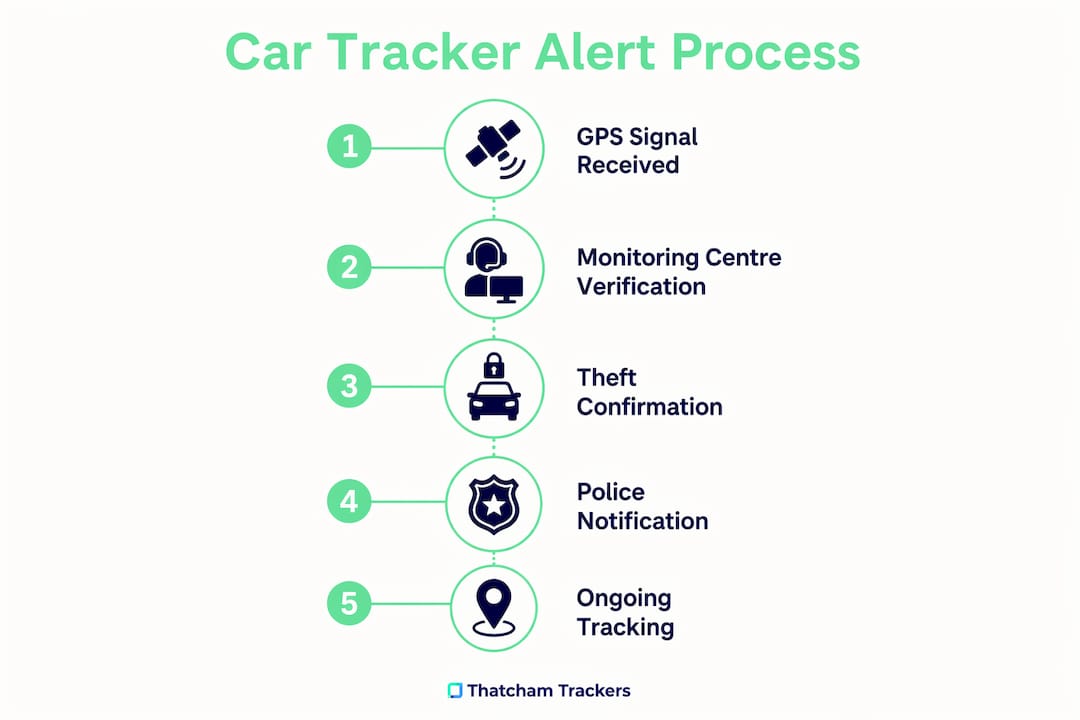
Here is how the full alert process works, step by step:
- Signal collection. The tracker’s GPS module locks onto satellite signals and records the vehicle’s precise coordinates, speed, and direction continuously.
- Data transmission. The device sends this data over a cellular network to a secure server, typically every few seconds during active tracking.
- Alert generation. If the vehicle crosses a pre-set geofence boundary, is moved without authorisation, or triggers a tamper sensor, the platform generates an alert automatically.
- Monitoring centre notification. The alert reaches a staffed monitoring centre, where trained operators review the data and attempt to contact the registered vehicle owner to confirm whether the movement is authorised.
- Police notification. If the owner confirms theft or cannot be reached, the monitoring centre contacts the police directly, providing live coordinates, vehicle registration, and movement history.
Modern GPS trackers deliver instant alerts to car owners’ smartphones alongside this backend process, meaning you may know your vehicle is moving before the monitoring centre has even called you. That dual notification system speeds up the verification step considerably.
Pro Tip: Register your mobile number and a backup contact with your monitoring centre. If operators cannot reach you quickly, the verification step slows down and so does the police call.

What role do police and monitoring centres play after receiving a car tracker alert?
Once a monitoring centre contacts the police with a confirmed theft, the response follows a structured grading system. UK police control rooms use a graded call system that classifies confirmed crimes in progress as Immediate, or Grade 1, requiring a response within 15 minutes. Officers are dispatched with incident details sent directly to their mobile data terminals and via radio, so they arrive with your vehicle’s last known location already on screen.
The monitoring centre’s role does not end at that first call. Operators continue to relay updated coordinates to the attending officers in real time, effectively guiding the response unit towards the moving vehicle. This live communication channel is what separates a tracked theft from an untracked one, where police have nothing more than a description and a last-seen location.
The results of this collaboration are measurable. Tracker’s partnership with UK police achieves an approximate 95% vehicle recovery rate, with half of stolen vehicles found within four hours and 80% recovered within 24 hours. That figure reflects what happens when verified, precise data reaches officers quickly.
Key factors that determine how effective the police response will be include:
- Verification speed. The faster the monitoring centre confirms the theft, the sooner police are notified.
- Data quality. Clean, time-stamped GPS coordinates allow officers to deploy efficiently rather than searching a wide area.
- Police equipment. Some forces have vehicles and helicopters fitted with dedicated tracker detection units, which can locate a vehicle even if it has been moved into a building or container.
- Communication continuity. Monitoring centres that maintain an open line with the attending officer throughout the recovery significantly improve outcomes.
“Verified, real-time GPS data from trackers enables police to focus their search precisely and respond faster, significantly increasing stolen vehicle recovery chances.” — Policing.uk
How do different car tracker technologies improve police alerts?
Not all trackers perform equally when it comes to generating reliable, timely alerts. The technology inside the device and the subscription tier you choose both affect how useful the data is when it reaches the police.
| Feature | Basic tracker | Thatcham-approved tracker |
|---|---|---|
| Update frequency | Every 60 seconds or longer | Every few seconds in real time |
| Tamper detection | Often absent | Standard inclusion |
| Backup battery | Rarely included | Typically included |
| Anti-jamming protection | Not standard | Present in higher-rated models |
| Monitoring centre | Self-managed app only | 24/7 professional centre |
| Police liaison | Owner must call police | Centre contacts police directly |
High-quality trackers include tamper detection, backup batteries, and anti-jamming features to maintain alert reliability even when thieves attempt to disable the device. This matters because professional vehicle thieves routinely use signal jammers to block GPS transmission. A tracker without anti-jamming capability goes silent the moment a jammer is activated, leaving the monitoring centre with no live data to pass to police.
GPS tracking converts vehicle theft recovery from guesswork into precise location tasks, drastically reducing the time officers spend searching. Police rely on clean, time-stamped data showing movement and last confirmed position to deploy units efficiently. A tracker that updates every 60 seconds rather than every few seconds can place a fast-moving vehicle several kilometres from its reported position by the time officers arrive.
Thatcham Research, the UK’s central automotive risk intelligence organisation, independently tests and certifies vehicle security systems. Devices rated to Thatcham S5 or S5 Plus standards meet the highest benchmarks for alert reliability, monitoring centre integration, and police liaison capability. Insurance companies use these ratings directly, often requiring or rewarding Thatcham-approved devices with lower premiums.
Pro Tip: Choose a tracker rated to at least Thatcham S5 if your insurer requires it. The S5 certification standard guarantees 24/7 monitoring centre support and direct police notification, which basic self-monitored trackers do not provide.
What are common misconceptions about how car trackers alert police?
Several widely held beliefs about car tracking technology are inaccurate, and acting on them can leave you with a false sense of security.
- Trackers do not alert police directly. The device itself has no direct line to a police control room. Police treat GPS tracker data differently from traditional sources; only actionable, recent, and accurate location data prompts immediate deployment. That data must be delivered by a monitoring centre, not by the tracker hardware itself.
- Your smartphone notification is not a police alert. Receiving a theft alert on your app means the system has detected unusual movement. It does not mean police have been contacted. You or your monitoring centre must still initiate that call.
- GPS signal loss is a real risk. Trackers lose signal in underground car parks, metal shipping containers, and areas with poor cellular coverage. A quality device with a backup battery and anti-jamming capability continues to record the last known position and resumes transmission when signal is restored.
- Older or cheaper trackers may have significant update delays. A tracker that pings its location every two minutes is not providing real-time vehicle tracking in any meaningful sense during a fast-moving theft. The gap between updates can translate directly into a failed recovery.
- Monitoring centres are not all equivalent. Some budget tracker subscriptions route alerts to automated systems rather than staffed centres. An automated system cannot verify theft, negotiate with a confused owner, or maintain a live dialogue with attending officers.
Understanding these limitations helps you make a more informed choice when selecting a device and subscription level.
How can car owners get the most from their tracker system?
Owning a tracker is only part of the equation. How you set it up and maintain it determines whether it performs when it matters most.
- Choose a Thatcham-approved device. Thatcham-approved trackers are independently certified to meet defined standards for alert speed, monitoring centre integration, and police liaison. This is the single most reliable indicator of real-world performance.
- Keep your contact details current. Your monitoring centre needs an accurate mobile number and a backup contact. Outdated details delay verification and slow the police notification process.
- Test your system periodically. Contact your monitoring centre annually to confirm your subscription is active, your details are correct, and the device is communicating properly.
- Use the app actively. Most modern trackers offer a companion app for real-time vehicle tracking. Checking it regularly means you will notice unusual movement quickly and can confirm or deny theft faster when the monitoring centre calls.
- Know how to report a stolen car. If your vehicle is taken, call your monitoring centre first, then dial 999 if the theft is confirmed in progress. The centre will handle police liaison, but having the crime reference number from police also helps with your insurance claim.
Pro Tip: When you report a stolen car, give the police your tracker’s monitoring centre contact number immediately. Officers can then communicate directly with the centre for live updates rather than relying solely on your account.
Key takeaways
A car tracker alerts police through a verified chain: GPS data reaches a monitoring centre, operators confirm the theft, and live coordinates are passed to police for a graded emergency response.
| Point | Details |
|---|---|
| Trackers do not call police directly | A monitoring centre verifies the alert and contacts police on your behalf. |
| Grade 1 police response applies | Confirmed vehicle theft in progress can trigger a response within 15 minutes under UK grading rules. |
| Tracker quality affects outcomes | Thatcham S5 and S5 Plus rated devices provide real-time updates, tamper detection, and 24/7 monitoring. |
| Recovery rates are high with police links | Tracker partnerships with UK police achieve approximately 95% recovery, with half of vehicles found within four hours. |
| Owner actions matter | Keeping contact details current and knowing your monitoring centre’s number directly speeds up police notification. |
Why police-linked tracking systems are worth taking seriously
From Thatcham Trackers’ perspective, the most underestimated part of car tracking technology is not the hardware. It is the monitoring centre relationship and the police liaison protocols behind it. Customers frequently ask whether a cheaper, self-monitored tracker will do the same job. The honest answer is that it will not. A device that sends an alert to your phone but has no staffed centre to call police is only as useful as your ability to respond immediately, at any hour, in any situation.
The 95% recovery rate associated with professional tracker and police partnerships is not a marketing figure. It reflects what happens when verified data reaches officers within minutes rather than hours. The difference between a recovered vehicle and a written-off claim often comes down to whether a monitoring centre was awake and working at 3am when your car left your driveway.
Thatcham Trackers recommends pairing any approved tracker with a subscription that includes 24/7 monitoring. The device alone is the starting point. The monitoring centre and its police contacts are where the real protection lies.
— Thatcham Trackers
Protect your vehicle with a Thatcham-approved tracker
Thatcham Trackers supplies insurance-approved tracking systems certified by Thatcham Research, the UK’s independent automotive security authority. Every device in the range is tested to defined standards for alert speed, monitoring centre integration, and police liaison capability.
Whether you drive a standard saloon or a high-value prestige vehicle, there is a certified option suited to your needs. The Thatcham S5 Plus delivers the highest level of real-time tracking and police alert capability available. For drivers comparing options, the tracker selection guide at Thatcham Trackers sets out which certification level suits each vehicle type and insurance requirement. Browse the full range of Thatcham-approved trackers to find the right fit.
FAQ
Does a car tracker automatically call the police?
No. A car tracker does not contact police directly. The device sends location data to a monitoring centre, where trained operators verify the theft and then notify police with live coordinates.
How quickly can police respond to a car tracker alert?
Under the UK’s graded call system, a confirmed crime in progress is classified as Grade 1, requiring a response within 15 minutes. The speed of that response depends on how quickly the monitoring centre verifies and reports the theft.
What is the difference between a Thatcham S5 and a basic GPS tracker?
A Thatcham S5 rated device includes 24/7 monitoring centre support, direct police liaison, tamper detection, and anti-jamming features. A basic GPS tracker typically sends alerts to your phone only, with no professional monitoring or police notification capability.
Can thieves block a car tracker signal?
Signal jamming is a known tactic used by vehicle thieves. High-quality trackers include anti-jamming features and backup batteries to maintain tracking even when interference is attempted, ensuring the last known location is still available to police.
Do I still need to report my car stolen if I have a tracker?
Yes. Call your monitoring centre immediately, then contact police on 999 if the theft is confirmed in progress. Your monitoring centre will handle live police liaison, but obtaining a crime reference number from police is still required for your insurance claim.