

A professionally fitted Thatcham S7 or S5 tracker, kept on an active monitored subscription, is what UK insurers recognise as “insurance approved” for theft cover. A plug-in OBD device without Thatcham certification, professional fitting, and ongoing monitoring rarely satisfies a policy condition, however good the app looks.
Three things need to be in place before an insurer will accept a tracker against a theft clause:
- Thatcham certification — the device carries an S7 or S5/S5+ rating from Thatcham Research.
- Professional installation — fitted by an accredited installer, not self-installed via an OBD port.
- An active monitored subscription — 24/7 monitoring plus a digital installation certificate the insurer can check.
Check your policy schedule or call your insurer today to confirm whether they specify S5 or S7, and whether they need sight of a Thatcham digital certificate before cover starts.
Table of Contents
- What does “insurance approved” actually mean for a tracker?
- S5 or S7: which Thatcham category do you actually need?
- Does a Thatcham tracker actually lower your premium?
- How do you get a tracker fitted and what paperwork do you need?
- Is it legal to fit a tracker, and what happens to your data?
- What should you check before buying a tracker for insurance?
- How does Thatcham Research actually test these devices?
- Ready to fit a compliant tracker? Here’s what Thatcham Trackers offers
- Sources
- FAQ
What does “insurance approved” actually mean for a tracker?
“Insurance approved” isn’t a marketing phrase. It refers to Thatcham Security Certification, an independent testing scheme that grades vehicle security products against fixed performance and safety criteria. Insurers lean on these ratings because they don’t have the resources to test every tracker on the market themselves.
Certification alone doesn’t guarantee your insurer will accept a specific device. Manufacturers negotiate recognition with insurers individually, so a Thatcham-rated tracker that one insurer accepts might need extra confirmation with another.
An insurance-approved tracker functions as an ecosystem, not a single gadget: the hardware, a live monitored subscription, and a valid installation certificate all have to hold together, and letting any one piece lapse can void your cover.
In practice, a monitored tracker works like this: a roaming SIM keeps the device connected wherever you park, GPS pinpoints the vehicle’s location, and motion sensors flag unauthorised movement. That signal goes to a 24/7 monitoring centre, which liaises with police to support recovery. This is the workflow insurers are actually paying for when they ask for a “Thatcham-approved” device.
- GPS and roaming SIM keep location data flowing continuously.
- Motion detection triggers an alert the moment the vehicle moves without authorisation.
- The monitoring centre contacts police directly, speeding up recovery.
S5 or S7: which Thatcham category do you actually need?
Most cars, vans, and motorbikes only need an S7 tracker. It covers GPS location, monitored alerts, and police liaison, and it’s the category most insurers mean when they simply say “Thatcham tracker” without further detail. S5 does everything S7 does, plus automatic driver recognition (ADR), which uses a tag or fob to confirm the vehicle is being driven by an authorised person.
The Thatcham S5 criteria run to a monitored centre meeting BS 8591, roaming SIM, motion detection, bi-directional transmission, and driver ID hardware. That extra layer explains why S5 tends to cost more and adds a tag you need to carry.
- S7 typically suits: standard cars, vans, and motorcycles where insurers just want location tracking and monitored alerts.
- S5 typically suits: high-value or premium vehicles where insurers specifically ask for driver recognition as an anti-theft measure.
- Legacy paperwork: older policy wording sometimes references “Cat 6” or “Cat 7” — Cat 6 roughly maps to S7, and Cat 7 to S5.
If your insurer’s letter doesn’t specify a category at all, S7 is usually the safer default — buying S5 when it isn’t required just adds cost and an extra fob to keep track of. When in doubt, check the category differences against your renewal documents before you order anything.
Does a Thatcham tracker actually lower your premium?
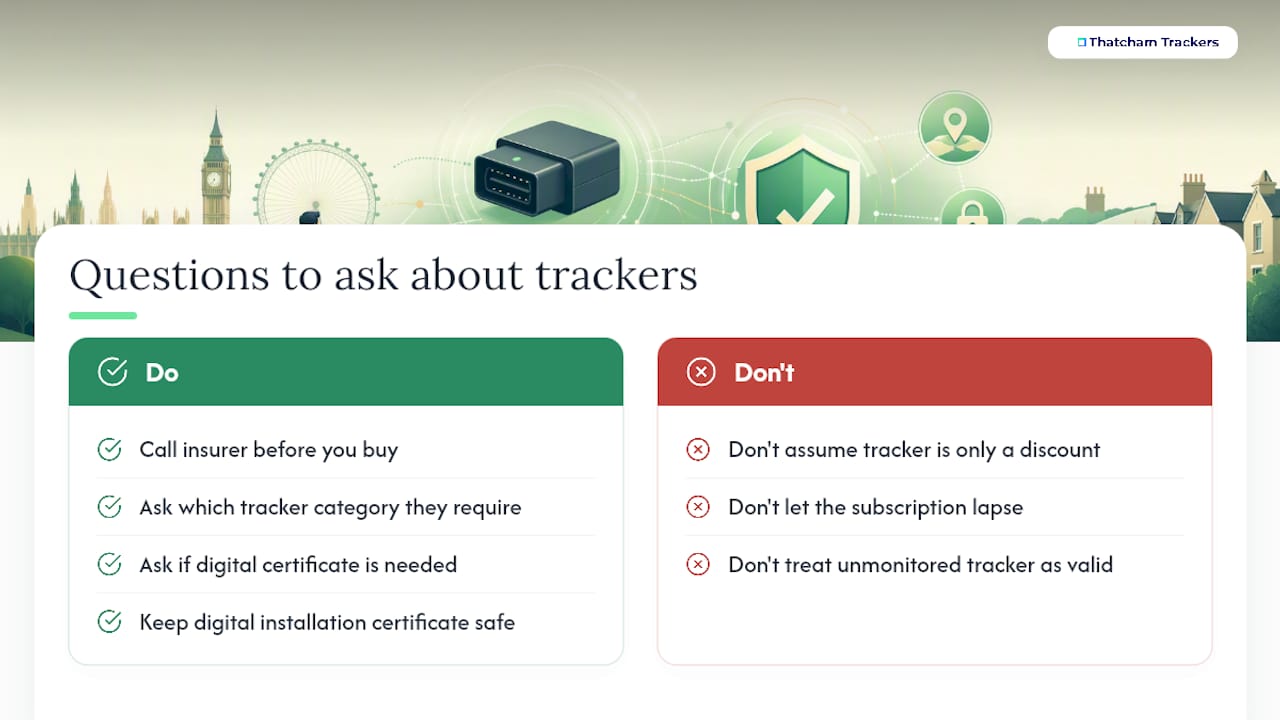
Sometimes yes, but the bigger issue is whether it protects your cover at all. Insurers write tracker requirements into policy schedules and endorsements, often as a condition of theft cover rather than a discount. That distinction catches people out: they assume a tracker is a nice-to-have for a cheaper quote, when it’s actually a contractual requirement for the claim to pay out.
A Financial Ombudsman Service ruling illustrates exactly how badly this can go wrong. A driver’s car was stolen, but the insurer declined the theft claim because the tracker’s subscription had lapsed. The Ombudsman only partially upheld the complaint, awarding modest compensation for distress rather than covering the theft loss itself.
A tracker that isn’t actively monitored at the moment of theft is, from the insurer’s perspective, the same as having no tracker fitted at all.
Before you buy, call your insurer and ask three things: which category they require, whether they need the digital installation certificate on file, and whether the tracker requirement affects your premium or is purely a condition of cover. Keep that certificate somewhere safe. It’s the document that proves compliance if a claim is ever disputed, as the practical case for insurance-approved trackers makes clear.
How do you get a tracker fitted and what paperwork do you need?
Getting fitted correctly isn’t complicated, but skipping a step is exactly how people end up with a device that doesn’t satisfy their insurer.
- Confirm the category your insurer requires directly from your policy documents, not from a tracker seller’s assumption.
- Choose a Thatcham-accredited installer rather than fitting an OBD-style device yourself, since insurers generally require professional fitting for full cover.
- Book a mobile or workshop installation — most fits for cars and vans take between one and two hours.
- Receive the digital installation certificate and store it alongside your policy documents.
- Activate the monitored subscription immediately; an installed but unmonitored tracker offers no protection at all.
Keep your certificate and subscription proof together with your policy schedule. If you ever need to make a claim, that paperwork is what stands between a smooth payout and a dispute.
Hardware and fitting costs vary by category and vehicle type, and monthly monitoring fees vary by provider, so it’s worth getting a current quote rather than assuming a fixed price. What matters more than the exact figure is the combination: hardware, a professional fit, and an active subscription, all documented. Full S7 installation timelines and expectations are worth reading before you book.
Is it legal to fit a tracker, and what happens to your data?
Fitting a tracker to your own vehicle is legal in the UK. Complications only arise if you’re tracking a vehicle you don’t own or have no legal interest in, which sits outside what this article covers and is worth checking with a solicitor if it applies to you.
On privacy, your location data flows from the device to the monitoring centre and, where relevant, to police during a recovery effort. Reputable providers publish exactly how they collect, use, and retain that data, and it’s worth reading that privacy notice before you commit, in the same way you’d check any service’s privacy statement before handing over personal data.
- Fitting a tracker to your own vehicle is lawful.
- Monitoring centres should meet BS 8591, the standard covering alarm receiving centres.
- Police response is often described as “Level 1”, meaning monitored, verified alerts get prioritised over unverified ones.
Pro Tip: Ask your provider directly whether their monitoring centre is BS 8591 compliant — it’s a one-line question, and a proper provider will answer it instantly.
What should you check before buying a tracker for insurance?
Before you hand over payment, run through this list against your policy wording.
- Confirm whether your insurer wants S5 or S7 (or the legacy Cat 6/Cat 7 equivalent) and whether they require a digital installation certificate.
- Check the installer is Thatcham-accredited, and that the package includes 24/7 monitoring, a roaming SIM, tamper resistance, and battery back-up.
- If S5 is specified, confirm driver ID tags are included and understand how they work day-to-day.
- Ask about subscription terms and cancellation policy upfront, not after you’ve paid.
- Confirm mobile installation availability if you can’t get to a fitting centre.
- Check whether your insurer requires a hardwired fit rather than a plug-in OBD-style device, since some insurers explicitly rule out plug-in units for theft cover.
Pro Tip: Photograph your installation certificate and email it to yourself the day you’re fitted. It’s the single easiest way to make sure you can find it again when a claim depends on it.
How does Thatcham Research actually test these devices?
Thatcham Research has operated as the UK’s vehicle security testing authority since the 1990s, and its certification programme remains the benchmark insurers reference when writing tracker conditions into policies.
For S5 and S7 approval, Thatcham’s technical criteria include a monitored centre compliant with BS 8591, a roaming SIM, motion detection, data logging, battery back-up, and a minimum period of resistance to tampering. S5 devices add automatic driver recognition on top of the S7 baseline.
Certification tells you the device performs reliably under test conditions. It does not tell you your specific insurer will accept it without question, so confirming with them directly remains the buyer’s job, not the manufacturer’s.
The 2026 national listing confirms S5 and S7 remain the active categories, and reiterates that certified tracking devices genuinely aid police recovery efforts, not just insurer paperwork.
Why we back professionally fitted, actively monitored trackers
The evidence here is consistent: a Thatcham S7 or S5 tracker only protects your cover when it’s professionally installed and kept live on a monitored subscription. A lapsed subscription or a missing certificate has cost real drivers real claims. Thatcham Trackers supplies S7, S5, and S5+ devices with nationwide installation and the digital certificate insurers ask for, built specifically around avoiding those gaps.
Ready to fit a compliant tracker? Here’s what Thatcham Trackers offers
Thatcham Trackers gives you a direct route to the exact category your insurer requires, without guessing which product actually satisfies your policy wording. The Thatcham Approved S7 range suits standard cars and vans, while the Thatcham Approved S5 and Thatcham Approved S5+ ranges add driver recognition for higher-value vehicles.
Every order includes fitting by an accredited installer, the digital installation certificate your insurer will ask to see, and 24/7 monitoring options, with mobile installation available across the UK rather than making you travel to a fitting centre. Before you book, have your policy schedule and vehicle details to hand so the fitter can confirm you’re getting the right category first time. Browse the full Thatcham-approved tracker range and book your fitting directly through Thatcham Trackers.
Sources
- Thatcham Security Certification - Thatcham Research
- VEHICLE SECURITY PRODUCT DEFINITIONS GUIDELINES - Thatcham Research
- Financial Ombudsman Service decision DRN-4141058
- Insurance-approved vehicle tracker: what one is and how it affects insurance - Insurd
FAQ
Which car trackers are insurance approved in the UK?
Trackers certified by Thatcham Research under the S7 or S5/S5+ categories are what UK insurers recognise, provided they’re professionally fitted and kept on an active monitored subscription.
Is a tracker Thatcham approved just by having GPS?
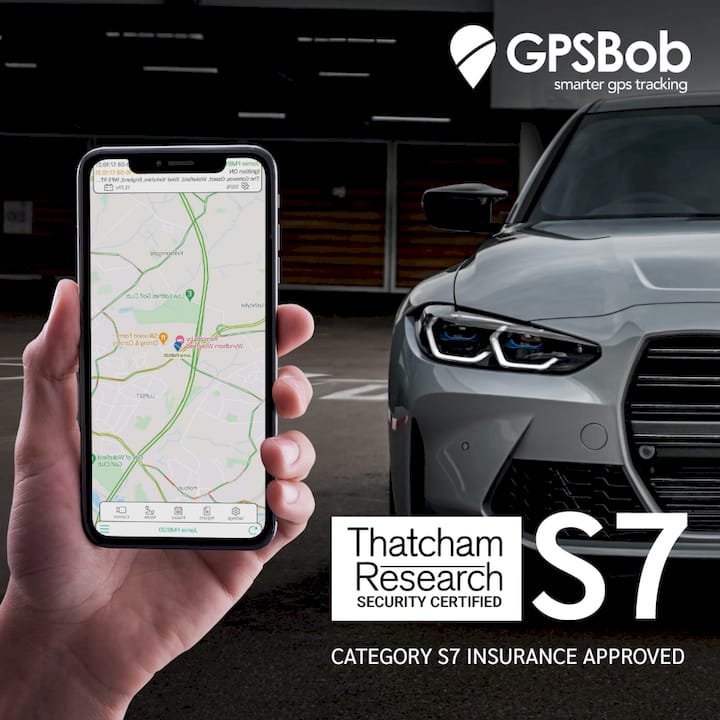
No. A device only carries Thatcham approval if it has been tested and certified against Thatcham’s specific S5 or S7 criteria, covering monitoring standards, tamper resistance, and battery back-up, not simply GPS functionality.
Is it illegal to put a tracker on a vehicle in the UK?
Fitting a tracker to a vehicle you own is legal. Complications only arise around tracking a vehicle you don’t own or have no legal right to monitor.
What car tracker is police approved?
There’s no separate “police approved” scheme. Monitored trackers linked to a BS 8591 compliant centre support what’s often called “Level 1” police response, where verified alerts are prioritised for faster action.
Can an OBD tracker meet insurer requirements?
Only if it carries Thatcham S5 or S7 certification and is professionally installed and monitored. A standalone plug-in OBD device without Thatcham certification, professional fitting, and an active subscription won’t usually satisfy an insurer’s theft cover condition.