

GPS vehicle tracking is the process of using satellite signals and cellular communications to determine and transmit a vehicle’s precise location and operational data to a remote user in near real time. The technology underpins everything from personal car security to large-scale fleet management. Platforms like Verizon Connect, Geotab, and Samsara have built entire businesses on top of it. The global GPS tracking market is projected to reach $4.76 billion by 2027, growing from $2.5 billion in 2022. That growth reflects how central vehicle tracking systems have become to both personal security and commercial operations.
What is GPS vehicle tracking and how does it work?
GPS vehicle tracking uses a process called trilateration to calculate a vehicle’s position. Trilateration, not triangulation, measures the distance between a device and at least four satellites by calculating how long a signal takes to travel from each satellite to the receiver. The result is a precise three-dimensional position: latitude, longitude, and altitude.

The accuracy of this process depends on atomic clocks inside each satellite. Those clocks are corrected for relativistic effects, meaning the physics of time at orbital speed. Without those corrections, positioning errors would accumulate rapidly and render the system unreliable.
Here is how the full process works, step by step:
- Signal reception: The GPS device in your vehicle receives signals from multiple satellites simultaneously.
- Position calculation: The device uses trilateration to calculate its exact location.
- Data transmission: The device sends that location data via a cellular or satellite modem to a remote server.
- User access: You view the data through a web portal or mobile app, typically with a 2–15 second delay from movement to displayed position.
One critical distinction: GPS trackers only receive satellite signals. They do not transmit data back to satellites. Location data travels via a separate cellular or satellite modem. This is why live tracking becomes unreliable in areas with poor mobile network coverage, not because the GPS signal is lost, but because the cellular connection is.
Pro Tip: If you need reliable live tracking in rural or remote areas, choose a tracker with a satellite modem rather than one that relies solely on cellular networks.
What are the main types of GPS vehicle trackers?
Vehicle tracking technology comes in several distinct forms. Each type suits different needs, budgets, and installation preferences.
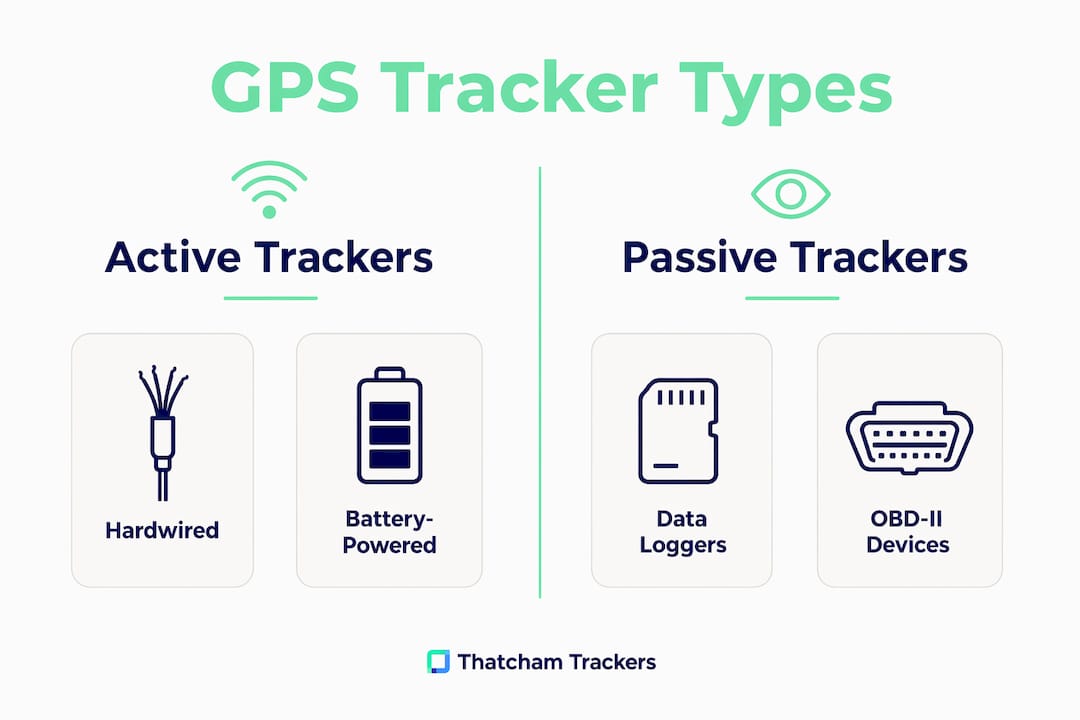
Active vs. passive trackers represent the most fundamental split. Active trackers transmit location data in real time via cellular networks. Passive trackers store location data internally and upload it later when the device connects to a computer or Wi-Fi. Active trackers are standard for fleet management and theft recovery. Passive trackers suit lower-cost personal use where live updates are not required.
Beyond that split, trackers differ by how they are installed and powered:
- Hardwired trackers connect directly to the vehicle’s electrical system. They draw power continuously, support advanced features like ignition detection and immobilisation, and are harder for thieves to locate and remove.
- OBD port trackers plug into the On-Board Diagnostics port, typically found beneath the steering column. Installation takes seconds and requires no tools. They are popular for fleet monitoring but are easier to remove or tamper with.
- Battery-powered portable trackers require no installation at all. They suit temporary use cases such as tracking hire vehicles, caravans, or assets that move between different vehicles.
| Tracker Type | Power Source | Installation | Best Use Case |
|---|---|---|---|
| Hardwired active | Vehicle battery | Professional fit | Fleet management, theft recovery |
| OBD port active | OBD port | Self-install | Small fleet monitoring |
| Battery-powered portable | Internal battery | No installation | Caravans, assets, temporary use |
| Passive data logger | Internal battery | No installation | Route recording, low-cost personal use |
For theft recovery specifically, a hardwired tracker installed in a concealed location is the most reliable option. Thatcham Trackers provides detailed guidance on hidden tracker installation for those who want to maximise security.
What are the key benefits of GPS vehicle tracking?
The advantages of GPS vehicle tracking extend well beyond simply knowing where a vehicle is. The technology delivers measurable improvements in security, cost, and safety for both individual owners and fleet operators.
The core benefits, in order of practical impact:
- Theft recovery. A GPS tracker gives police the real-time location of a stolen vehicle, dramatically improving recovery rates. Without a tracker, a stolen car is statistically unlikely to be recovered intact.
- Insurance premium reductions. Insurance companies offer discounts for vehicles fitted with approved trackers because they reduce risk profiles and support objective verification of driver behaviour. Thatcham-approved devices carry particular weight with UK insurers.
- Fuel cost savings. GPS-based route optimisation can cut fleet fuel costs by up to 20%. For a fleet of ten vehicles, that saving is significant on an annual basis.
- Driver safety improvements. Telematics and GPS tracking reduce speeding by a median of 48.6% across monitored fleets. Safer driving also reduces wear on vehicles and lowers accident-related costs.
- Operational efficiency. Fleet managers can monitor vehicle utilisation, identify idle time, and automate mileage reporting. These gains compound over time.
“The real value of GPS tracking is derived from software features like analytics, geofencing alerts, and automated reporting, not from hardware alone.” — Samsara
That point is worth emphasising. The hardware is the foundation, but the telematics software is where the financial and safety benefits are actually realised. A tracker without a capable software platform is like a dashcam without a screen.
For individual car owners, the insurance angle is particularly compelling. You can read a detailed breakdown of how tracker insurance discounts work in practice, including which policy types benefit most.
How to choose the right GPS tracking system for your needs
Selecting the right vehicle tracking system requires matching the technology to your specific use case. The wrong choice wastes money and delivers a poor experience.
Key factors to evaluate
Power and connectivity. Hardwired trackers offer continuous power and the most reliable data transmission. OBD trackers are convenient but can be unplugged. Battery-powered units need regular charging or replacement.
Data update frequency. Some trackers update every 10 seconds. Others update every 60 seconds or only when the vehicle is moving. For live fleet management, frequent updates matter. For theft recovery, less frequent updates are often sufficient.
Software and alerts. Geofencing is one of the most practical features available. It sends an alert when a vehicle enters or leaves a defined area, such as a depot, school zone, or restricted region. Platforms like Geotab and Samsara offer geofencing as standard. Ensure the tracker you choose is compatible with a software platform that includes this feature.
Thatcham approval. In the UK, Thatcham Research independently tests and certifies vehicle security systems. Insurance companies use these ratings to assess theft risk. A Thatcham-approved tracker carries a recognised certification that insurers accept, often resulting in lower premiums or becoming a policy requirement for high-value vehicles.
Pro Tip: Do not assume cellular coverage is consistent across your operating area. Test your chosen tracker’s update reliability on the actual routes your vehicles travel before committing to a full fleet rollout.
For those interested in how GPS tracking functions across borders, Thatcham Trackers has published a clear guide on international GPS tracking that covers roaming, coverage gaps, and cross-border fleet management.
Pairing a GPS tracker with a dashcam also strengthens your position with insurers. Fleet dashcams deter reckless driving and provide objective incident data that supports insurance claims. Some insurers now reward fleets that combine both technologies with further premium reductions.
Key takeaways
GPS vehicle tracking delivers measurable security, cost, and safety benefits only when the right tracker type is matched to a capable telematics software platform.
| Point | Details |
|---|---|
| Trilateration powers GPS accuracy | GPS uses signals from four or more satellites to calculate precise 3D position, not triangulation. |
| Cellular modems transmit data | Trackers receive GPS signals but send location data via cellular networks, causing gaps in dead zones. |
| Thatcham approval matters in the UK | Thatcham-certified trackers are recognised by insurers and can reduce premiums or satisfy policy requirements. |
| Software unlocks the real value | Geofencing, analytics, and automated reporting deliver the operational and financial benefits, not hardware alone. |
| Tracker type must match the use case | Hardwired trackers suit security and fleets; OBD trackers suit convenience; portable units suit temporary tracking. |
GPS tracking has changed more than most people realise
From Thatcham Trackers’ perspective, the most consistent misconception we encounter is that GPS tracking is simply about knowing where a vehicle is. That framing undersells the technology significantly.
GPS tracking is now industry standard in fleet management for small and medium-sized enterprises, not just large logistics operations. The cost of entry has dropped considerably, and the software platforms have become genuinely accessible to non-technical users.
What surprises most individual car owners is the insurance angle. Many assume a tracker is a luxury add-on. For high-value vehicles, prestige cars, and modified cars, it is increasingly a policy requirement. Thatcham Research’s certification process exists precisely to give insurers a reliable standard to reference. A device that carries a Thatcham S5 or S7 rating has been independently tested and verified. That matters to underwriters in a way that an uncertified tracker simply does not.
The next development worth watching is the integration of GPS tracking data with AI-driven analytics. Platforms are beginning to predict maintenance needs, flag driver fatigue patterns, and model accident risk from telematics data. The hardware is largely commoditised. The intelligence layer built on top of it is where the real differentiation is heading.
— Thatcham Trackers
Thatcham-approved GPS trackers from thatcham trackers
Thatcham Trackers supplies a range of insurance-approved vehicle tracking systems certified by Thatcham Research. Whether you need a tracker for a personal vehicle, a prestige car, or a commercial fleet, the right certified device can reduce your insurance premium and improve your theft recovery prospects.
Browse the full range of Thatcham-approved trackers to find a device matched to your vehicle and insurer requirements. If you are unsure which certification level applies to your policy, the tracker selection guide walks you through the decision clearly. Thatcham Trackers is rated 4.8 out of 5 on both Trustpilot and Google Reviews.
FAQ
What is GPS vehicle tracking in simple terms?
GPS vehicle tracking is the use of satellite signals and cellular communications to monitor a vehicle’s location and movement remotely. A small device fitted to the vehicle calculates its position and sends that data to a web portal or app.
How does GPS tracking work in a car?
A GPS tracker in a car receives signals from at least four satellites to calculate its position using trilateration. It then transmits that location data via a cellular modem to a remote server, with a typical update delay of 2–15 seconds.
Does GPS tracking work without mobile signal?
The GPS receiver continues to calculate position without mobile signal, but it cannot transmit that data in real time. Location updates will resume once the vehicle re-enters cellular coverage.
What is a thatcham-approved tracker?
A Thatcham-approved tracker is a vehicle tracking device independently tested and certified by Thatcham Research, the UK’s central automotive risk intelligence organisation. Insurers use these ratings to assess theft risk and may require or reward certified devices with lower premiums.
Can GPS tracking reduce my car insurance premium?
Yes. Insurers offer discounts for vehicles fitted with approved GPS trackers because they reduce theft risk and support objective driver behaviour verification. Thatcham-certified devices carry the most recognised standard for UK insurers.