

If your insurer requires a Thatcham-approved tracker, book a professional installation. Full stop. Self-install units have their place, but they will not satisfy an insurance condition and will not carry the recovery weight a Thatcham S5 or S7 device does.
The distinction matters because insurers do not ask for “a tracker”. They ask for a specific certified category, fitted a specific way, with paperwork to prove it. Get the category wrong or the fitting wrong, and the policy condition remains unmet even though a tracker is sitting in the car.
Here is the decision, stripped back:
- Insurer requires a tracker as a policy condition → buy a Thatcham S5 or S7 device from Thatcham Trackers and book professional fitting.
- No insurance requirement, just personal peace of mind or temporary asset tracking → a self-fit battery or OBD unit may be adequate.
- Unsure which category your policy demands → check your renewal documents or call your insurer before ordering anything.
Table of Contents
- Choosing between EV tracker installation methods
- What do Thatcham S5 and S7 certification actually require?
- What happens on installation day?
- How much does EV tracker installation cost?
- Is it legal to fit a tracker on your car in the UK?
- What should you ask an installer before booking?
- What UK EV owners consistently get wrong
- Getting your Thatcham-approved tracker fitted
- Sources
- FAQ
Choosing between EV tracker installation methods
Two installation routes exist, and they are not interchangeable once insurance is involved.
Professional hardwired installation means an accredited engineer visits your EV, taps into a permanent power source, and hides the device inside the vehicle’s structure, often behind trim panels, inner wing liners, or dash cavities. Self-install units are battery-powered or plug into the OBD port, and you fit them yourself in minutes with no wiring involved.
The trade-offs are not subtle:
- Power source and longevity. Hardwired trackers draw from the vehicle’s permanent supply and run indefinitely. Battery units need recharging or replacement, and a flat battery means no signal exactly when you need one.
- Detectability. A hardwired unit hidden in a factory void is hard for a thief to find in the time they have on your driveway. An OBD dongle plugged into the port under the dash is often the first thing an experienced car thief checks and removes.
- Tamper resistance and reliability. Thatcham-grade devices are built and fitted to resist interference, which is precisely what insurers are paying for when they set the requirement.
EVs raise the stakes further. High-voltage battery packs and management cabling run through areas an untrained installer could easily misjudge, risking both damage and a compromised fit. Fitters experienced with EV platforms know which cavities are safe and which wiring diagrams to check for each make and model, reducing the risk of trim damage and preserving your warranty conditions.
For fleet operators focused on theft recovery, hardwired Thatcham devices are the only sensible route. For someone tracking a trailer or a low-value asset with no insurance stake, a self-fit unit can do the job adequately.
What do Thatcham S5 and S7 certification actually require?
Thatcham S5 covers vehicle tracking systems; S7 covers asset location systems, typically used for vans, plant, and towed equipment. Both categories exist under Thatcham Research’s vehicle security product definitions, which set out the minimum performance bar a device must clear before it earns the label insurers recognise.
Certified S5 and S7 devices must include:
- A 24/7 monitored service centre that can respond the moment a vehicle moves without authorisation.
- A roaming SIM so the device stays connected across networks rather than relying on a single provider.
- Battery back-up, so cutting the main power supply does not silence the tracker.
- Resistance to attack, meaning the unit is built to withstand tampering, not just detect it.
- Driver ID functionality on certain S5+ variants, useful where multiple drivers use one vehicle.
Thatcham Security Certification is the industry benchmark for aftermarket vehicle security. Products go through rigorous, predefined testing before they appear in Thatcham’s certification database, and insurers lean on that listing when deciding what satisfies a policy condition.
Here is the part many owners miss: certification is not just about the hardware. Thatcham’s own standards expect professional fitting and an installation certificate as part of what makes a device count as genuinely certified in the eyes of an insurer. A Thatcham-listed tracker fitted badly, or fitted by someone with no accreditation, does not deliver the same assurance as one installed correctly. Meet the standard properly and insurers typically offer stronger recovery support and, in some cases, a more favourable view on premiums.
What happens on installation day?
Preparation starts before the engineer arrives, ensuring the installer is aware of essential EV installation and charging considerations to handle battery safety and wiring correctly. Check your policy wording for the exact tracker category required, keep your V5C and insurance renewal letter to hand, and confirm your EV’s make, model, and any known EV-specific wiring quirks with the installer beforehand.
On the day, expect this sequence:
- Arrival checks. The engineer inspects the vehicle, identifies suitable hidden mounting points, and reviews wiring diagrams specific to your EV to avoid high-voltage cabling and battery management systems.
- Fitting. The device is hardwired into a permanent power feed and secured somewhere a thief is unlikely to find or reach, often behind trim, inside wing liners, or within factory voids that avoid high-voltage runs.
- Configuration. Tamper detection is activated, the unit is registered to the 24/7 monitoring centre, and its serial number is logged against your vehicle.
- Certification. You receive an installation certificate naming the installer and confirming the fit meets Thatcham requirements, the document your insurer will ask to see.
Most professional fits take between one and three hours on site, and appointments are commonly available within 48 to 72 hours of booking across mainland UK.
Pro Tip: Photograph the engineer’s ID and the device’s serial number before they leave. If your insurer ever queries the fit at renewal, you want that evidence to hand immediately, not weeks later.
How much does EV tracker installation cost?
Budgeting for this is straightforward once you know what you are paying for: hardware, fitting, and ongoing monitoring are three separate costs.
- Device price. Thatcham-approved S5 and S7 units generally sit at a higher price point than basic self-fit trackers, reflecting the certified hardware, monitoring integration, and tamper resistance built in.
- Fitting fee. A one-off professional installation charge covers the engineer’s time, hardwiring, and certificate issuance.
- Monitoring subscription. Most Thatcham devices run on a monthly or annual subscription that covers the 24/7 monitoring centre and police liaison during a theft recovery.
Appointment lead times run around 48 to 72 hours from order to fitting, with the visit itself typically wrapped up in one to three hours. If your renewal date is approaching, book earlier rather than later. Insurers checking for a valid certificate at renewal will not accept “it’s booked in” as proof of compliance.
Is it legal to fit a tracker on your car in the UK?
Fitting a tracker to a vehicle you own is generally lawful. Fitting one to a vehicle you do not own, or monitoring another person’s movements without a lawful basis, is a different matter entirely, and can engage the Protection from Harassment Act, the Computer Misuse Act, and UK GDPR depending on the circumstances, according to legal analysis of GPS tracking law.
Fleet managers carry additional obligations. Tracking company vehicles is lawful, but only when done properly.
Employers must inform drivers that tracking is in place, carry out a Data Protection Impact Assessment, and establish a documented lawful basis before switching on monitoring. Tracking a driver’s personal vehicle, or continuing to monitor a company vehicle outside working hours, needs particular care under UK GDPR.
- Run a DPIA before rolling out fleet-wide tracking, not after a driver complains.
- Give written notice to every driver, not a verbal mention in a team meeting.
- Build in a privacy mode that stops monitoring outside working hours to keep GDPR risk and driver relations in check.
The Association of British Insurers treats GPS tracking as an aid to physical surveillance rather than standalone proof, so tracking data should support a recovery or investigation, not act as the sole evidence in a dispute. If you suspect an unauthorised tracker has been fitted to your vehicle, a professional sweep is the sensible route rather than removing anything yourself.
What should you ask an installer before booking?
Vet the installer with the same rigour you would apply to any tradesperson working on your EV’s electrics.
- Ask for the exact device model and confirm it appears on the Thatcham certification database, not just a claim that it is “Thatcham approved”.
- Ask for the engineer’s accreditation, and confirm they have experience fitting to EV platforms specifically.
- Confirm you will receive an installation certificate naming the installer, plus registration to a 24/7 monitored centre.
Red flags to walk away from: no certificate offered, reluctance to hardwire the unit, or anyone suggesting a “DIY certificate” for a self-fit device. Insurers will not accept either. At handover, record the device serial number, take photographs of the fitted unit, and keep the certificate somewhere you can find it at renewal.
Pro Tip: Ask the installer to show you the fitted device’s location before they close up the panels. You will not remember exactly where it is a year later, and neither will a garage doing unrelated bodywork.
What UK EV owners consistently get wrong
The conventional advice on this topic treats tracker installation as a hardware decision. It is not. It is a compliance decision that happens to involve hardware.
Most guides fixate on which device has the most features, when the question that actually determines whether your insurer accepts the fit is whether an accredited engineer hardwired it, registered it to a monitoring centre, and issued a certificate with their name on it. A Thatcham S5 sitting in a box on your passenger seat protects nothing and satisfies no one.
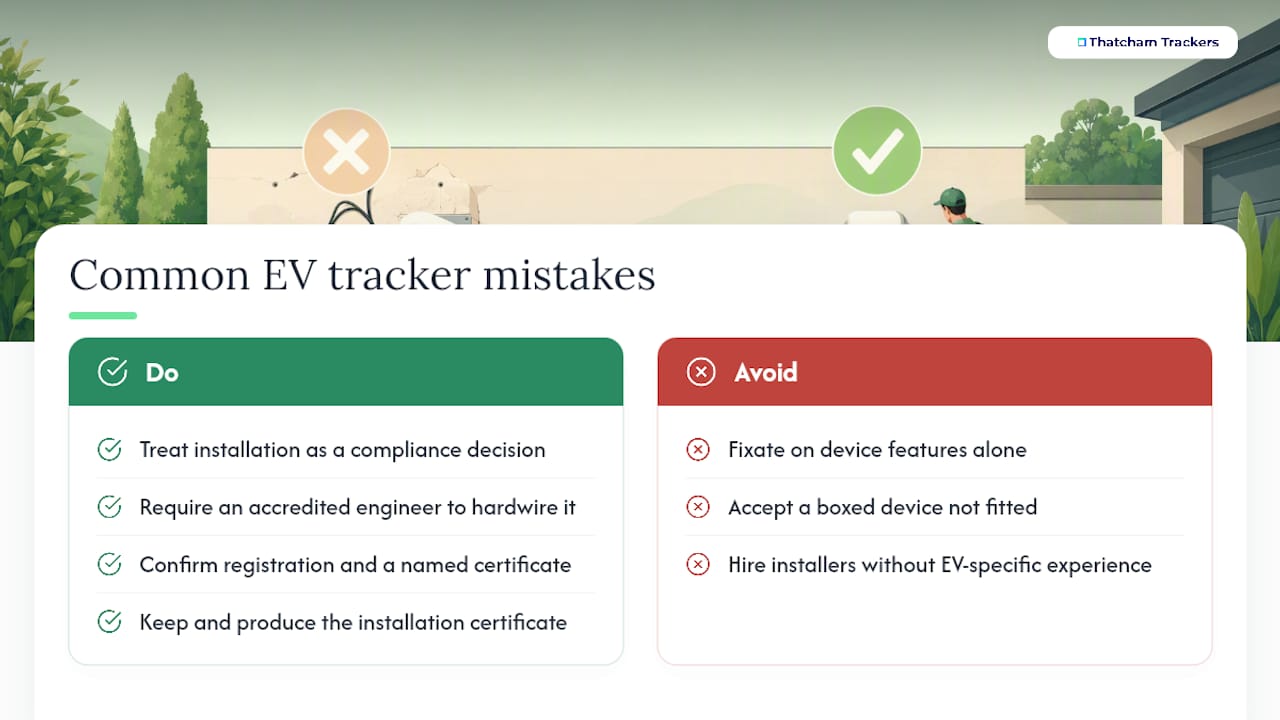
The EV angle gets underplayed too. Battery packs and high-voltage cabling are not a footnote, they are a genuine reason to insist on an installer who has fitted trackers to electric platforms before, not just petrol and diesel cars. Ask that question before you ask about price.
If there is one habit worth building, it is this: treat the installation certificate with the same seriousness as your MOT certificate. Keep it, know where it is, and produce it the moment your insurer asks. That single document is what separates a compliant fit from an expensive piece of electronics doing nothing for your premium.
— Thatcham Trackers
Getting your Thatcham-approved tracker fitted
Thatcham Trackers sells Thatcham-approved S5 and S7 devices and arranges nationwide mobile installation, so you are not left sourcing a certified unit and a qualified engineer separately.
Every order includes the fitted device, enrolment with the 24/7 monitoring centre, and the installation certificate your insurer will ask for at renewal, the exact combination outlined earlier in this guide. If your vehicle carries higher value or you need driver ID functionality, the S5+ range covers that requirement directly. For vans, fleets, and asset-tracking needs, the S7 collection is the category most insurers expect to see. Check your policy wording for the required category, then choose the matching product and book your mobile fitting appointment. Nationwide slots typically open up within 48 to 72 hours.
Sources
- Vehicle security product definitions guidelines (Thatcham Research)
- ABI tracking policy and guidance (Association of British Insurers)
- UK car tracking explained — Sentry Private Investigators
FAQ
Is it illegal to put a tracker on a vehicle in the UK?
Fitting a tracker to your own vehicle is generally lawful. Fitting one to someone else’s vehicle, or monitoring another person without a lawful basis, can breach the Protection from Harassment Act, the Computer Misuse Act, and UK GDPR.
How much does a tracker cost in the UK?
Costs break down into three parts: the device itself, a one-off professional fitting fee, and an ongoing monthly or annual monitoring subscription that covers the 24/7 monitoring centre and police liaison.
What is the best car tracking device in the UK?
For insurance compliance, the best option is a device certified under Thatcham S5 or S7, since these are the categories insurers recognise and often require as a policy condition.
What is the best GPS tracker for electric cars?
A Thatcham-approved S5 or S7 device fitted by an installer experienced with EV platforms is the strongest choice, since EVs require careful handling around high-voltage cabling and battery management systems during fitting.
Does a self-install tracker satisfy an insurance requirement?
No. Insurers generally require a Thatcham-certified device fitted professionally with an installation certificate, which a self-fit battery or OBD unit cannot provide.