

Vehicle tracking technology is defined as any system that monitors and records a vehicle’s location, movement, and operational data using satellite signals, cellular networks, or a combination of both. The three primary types of vehicle tracking technology are hardwired trackers, OBD-II plug-in units, and battery-powered devices, each with distinct installation methods, power sources, and use cases. Thatcham-approved trackers sit at the top of the security hierarchy in the UK, certified by Thatcham Research, the country’s central automotive risk intelligence organisation. Understanding which type suits your vehicle or fleet is the first step toward better security, lower insurance premiums, and more effective fleet management. Trackers typically update every 10–30 seconds for real-time management, making the choice of technology directly relevant to operational performance.
1. What are hardwired vehicle tracking systems?
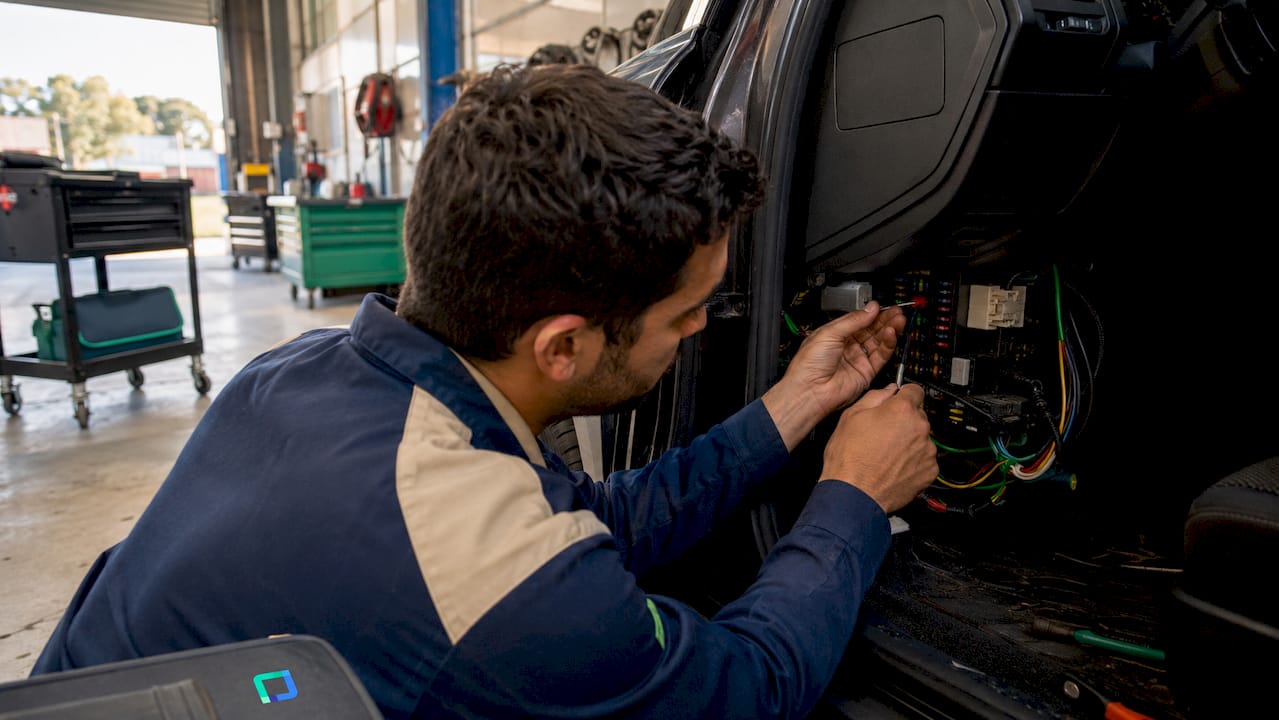
Hardwired trackers connect directly to a vehicle’s electrical system, drawing constant power without relying on a battery or ignition cycle. This permanent connection means the device is always active, always reporting, and far harder to defeat than a plug-in alternative. Hardwired trackers monitor ignition status and provide tamper alerts, making them the preferred choice for high-value vehicles and commercial fleets.
Key features of hardwired systems include:
- Constant power supply from the vehicle’s own electrical system
- Discreet installation behind the dashboard or within the vehicle’s bodywork
- Frequent real-time updates supporting detailed telematics reporting
- Tamper detection that triggers alerts if the device is interfered with
- Deep telematics integration covering fuel use, driver behaviour, and diagnostics
The main drawback is installation complexity. Professional fitting is required, which adds upfront cost. For a long-term commercial fleet, that cost is recovered quickly through better route management and theft recovery rates.
Pro Tip: Hardwired trackers are the best choice for any fleet where vehicles operate continuously and security is a priority. The hidden installation guide from Thatcham Trackers covers placement options that maximise both discretion and signal quality.
2. How do OBD-II plug-in trackers work?
OBD-II trackers plug directly into a vehicle’s on-board diagnostics port, which is a standardised socket found in most cars built after 1996, typically located beneath the steering column. Installation takes under a minute and requires no tools or technical knowledge. OBD-II trackers access engine diagnostics data alongside location, giving users a richer picture than basic GPS alone.
Key features of OBD-II systems include:
- No-tool installation via the standard diagnostics port
- Engine data access including fault codes, RPM, and fuel efficiency
- Easy relocation between vehicles in a small fleet
- Cost-effective entry point for individuals and small business owners
- Ignition-dependent power, meaning the tracker only operates when the vehicle is running
The limitation is visibility. The OBD-II port sits in plain sight, so a thief who knows what to look for can remove the tracker in seconds. This makes OBD-II units unsuitable as a sole security measure for high-risk vehicles.
Pro Tip: OBD-II trackers work well for monitoring driver behaviour and fuel costs in small fleets. For theft protection, pair them with a hardwired unit or a Thatcham-approved S5 tracker for certified security.
3. What defines battery-powered and solar vehicle trackers?
Battery-powered GPS trackers offer flexibility for assets like trailers, machinery, and containers that have no permanent electrical connection. These devices require no wiring at all. Many models include magnetic mounts, allowing placement on any metal surface in seconds.
Key features of battery-powered and solar units include:
- No wiring required, making them suitable for trailers and non-powered equipment
- Magnetic mounting options for quick, tool-free installation
- Variable battery life ranging from weeks to years depending on reporting frequency
- Solar charging capability on some models to extend operational life
- Covert placement in locations a hardwired unit cannot reach
The trade-off is reporting frequency. A battery-powered tracker set to update every few minutes will drain its power source far faster than one set to report hourly. Choosing the right reporting interval is the single most important decision when deploying these devices.
Pro Tip: For trailers and plant equipment, a 4G GPS asset tracker with magnetic mounting gives you flexible placement with modern network compatibility. Always confirm 4G support before purchasing.
4. How do satellite and cellular networks enable vehicle tracking?
The communication method a tracker uses determines where it works, how fast it reports, and what it costs to run. Most vehicle tracking systems in the UK rely on cellular networks to transmit location data to a server, which then displays it in a web or mobile application.
4G and 5G cellular networks cover over 90% of typical commercial and personal vehicle use. That coverage figure means cellular is the practical default for the vast majority of fleets and individual users. Real-time update latency via cellular networks is around 2 seconds, which is sufficient for live fleet monitoring and theft response.
Satellite communication fills the gap where cellular signals cannot reach. Satellite tracking is used mainly for specialised operations such as mining, remote freight, and offshore logistics. The coverage is global, but the hardware and subscription costs are considerably higher than cellular equivalents.
GPS positioning itself relies on GNSS satellite constellations. GPS uses trilateration, measuring distances from multiple satellites rather than triangulating angles, and requires signals from at least four satellites for accurate 3D positioning. GPS accuracy reaches approximately 2.5 metres in good conditions, though urban canyons and dense buildings reduce this.
| Feature | Cellular (4G/5G) | Satellite |
|---|---|---|
| Coverage | Over 90% of commercial routes | Global, including remote areas |
| Update speed | Around 2 seconds | Slower, varies by provider |
| Cost | Lower monthly subscription | Higher hardware and data costs |
| Best use | Urban and suburban fleets | Remote, off-grid operations |
| Network longevity | Strong, actively expanding | Stable but expensive |
5. How does GPS positioning actually work?
GPS tracking systems calculate a vehicle’s position using trilateration across a network of GNSS satellites. The receiver in the tracker measures the time it takes for signals to arrive from multiple satellites and uses those distances to calculate a precise location. At least four satellites are needed for a reliable three-dimensional fix.
GPS accuracy is approximately 2.5 metres under good sky conditions. That level of accuracy is more than sufficient for fleet routing, theft recovery, and geofence alerts. Accuracy degrades in dense urban environments where tall buildings block or reflect satellite signals, a phenomenon known as multipath interference. Understanding how international GPS tracking works is particularly relevant for fleets that cross borders or operate in varied terrain.
6. How to choose the right vehicle tracking method for your needs
Selecting the right vehicle tracking method depends on four factors: vehicle type, installation preference, data requirements, and budget. Matching these factors to the correct technology avoids overspending and underperforming.
Telematics integration amplifies the value of vehicle tracking by delivering performance data such as fuel consumption, driver behaviour, and vehicle diagnostics. For fleets where operational efficiency matters as much as security, a hardwired system with full telematics is the correct choice. For individuals who want basic location monitoring and theft alerts, an OBD-II unit or a Thatcham-approved S7 tracker provides sufficient capability at lower cost.
| Technology | Power source | Installation | Data richness | Relative cost | Best for |
|---|---|---|---|---|---|
| Hardwired | Vehicle electrical | Professional | High | Higher | Commercial fleets, high-value cars |
| OBD-II | Ignition-dependent | Self-install | Medium | Lower | Small fleets, individual users |
| Battery-powered | Internal battery | Self-install | Lower | Variable | Trailers, equipment, covert use |
| Satellite | Battery or hardwired | Professional | Medium | Highest | Remote or off-grid operations |
For UK drivers, Thatcham Research certification adds a further dimension to this decision. Insurance companies recognise Thatcham-approved ratings and frequently reduce premiums for vehicles fitted with certified devices. A VTS vehicle tracking system that carries Thatcham approval delivers both operational tracking and insurance benefit in a single device.
Pro Tip: Check your insurance policy before purchasing. Many UK insurers specify a minimum Thatcham category, particularly for high-performance or high-value vehicles. Fitting a non-approved tracker may not satisfy the policy requirement.
7. Network compatibility: why 4G and 5G readiness matters
Network compatibility is the most overlooked factor when purchasing a vehicle tracker. Older GPS tracker models risk becoming obsolete within 1–2 years without modern network support, as 2G and 3G networks are being phased out globally. A tracker purchased today must support 4G LTE as a minimum.
4G and 5G capability is vital for long-term viability in any tracker purchased in 2026. Buying a device that still relies on 3G connectivity is a false economy. The hardware cost saving is eliminated the moment the network it depends on is switched off. Always confirm the network generation supported before committing to a subscription.
Key takeaways
The most effective vehicle tracking strategy matches the technology type to the vehicle’s power source, the user’s installation capability, and the level of data required.
| Point | Details |
|---|---|
| Match type to vehicle | Hardwired suits permanent fleets; battery-powered suits trailers and unpowered assets. |
| OBD-II for convenience | OBD-II trackers install in seconds but lack discretion and theft-resistance. |
| Cellular covers most needs | 4G cellular networks cover over 90% of commercial routes, making satellite a specialist choice. |
| Verify network generation | Only purchase trackers with 4G LTE or 5G support to avoid early obsolescence. |
| Thatcham approval adds value | Thatcham-certified devices satisfy UK insurer requirements and can reduce premiums. |
Thatcham Trackers’ view on vehicle tracking in 2026
The most common mistake we see is treating vehicle tracking as a single category. Buyers compare price points without comparing technology types, then fit a device that does not match their actual need. A battery-powered tracker on a daily-use company car is the wrong tool. A hardwired unit on a trailer with no electrical system is simply impossible.
A hybrid approach combining hardwired and battery-powered units delivers the best coverage for mixed fleets. Hardwired devices handle the powered vehicles with full telematics. Battery units cover the trailers and equipment. The two systems work together through a single fleet management platform.
The second issue is network longevity. Customers occasionally contact us after purchasing a tracker from an unknown supplier, only to discover it runs on 3G. That device has a limited operational life regardless of how well it functions today. Confirming 4G or 5G support before purchase is non-negotiable.
Finally, do not underestimate the value of Thatcham approval. The certification is not just a badge. It reflects independent testing by Thatcham Research and carries direct financial benefit through insurance recognition. For UK drivers, it is the most reliable quality signal available in the vehicle security market.
— Thatcham Trackers
Thatcham-approved trackers for security and peace of mind
Thatcham Trackers supplies insurance-approved vehicle tracking devices certified by Thatcham Research. Every device in the range has been independently tested and rated, giving UK drivers and fleet operators confidence that their tracker meets insurer requirements.
The range includes Thatcham-approved S5 trackers, S7 category devices, the 5-year two-wire GPS tracker for long-term hardwired use, and Ghost immobilisers for keyless entry protection. Professional installation is available across the UK. Visit Thatcham Trackers to find the right device for your vehicle, confirm insurance compatibility, and book fitting.
FAQ
What are the main types of vehicle tracking technology?
The three main types are hardwired trackers, OBD-II plug-in units, and battery-powered devices. Each differs in power source, installation method, and the depth of data it provides.
How does real-time vehicle tracking work?
A GPS receiver in the tracker calculates position using signals from at least four GNSS satellites, then transmits that data via a cellular or satellite network to a web or mobile platform. Update intervals are typically every 10–30 seconds for live fleet monitoring.
What is the difference between Thatcham S5 and S7 trackers?
Thatcham S5 trackers provide stolen vehicle tracking with driver identification, while S7 devices offer tracking without driver ID verification. S5 carries a higher security rating and is more commonly required by insurers for high-value vehicles.
Are OBD-II trackers secure enough for theft protection?
OBD-II trackers are visible and removable, making them unsuitable as a sole theft deterrent. For genuine security, pair an OBD-II unit with a hardwired or Thatcham-approved device.
Do I need a subscription for a vehicle tracker?
Most vehicle trackers require a monthly or annual subscription to access the cellular network and tracking platform. Subscription costs vary by provider and network generation. Always confirm ongoing costs before purchasing, as the hardware price is only part of the total investment.