

Anti-jamming tracker technology is defined as a specialised vehicle security system that detects and counteracts deliberate GPS signal interference to maintain continuous location tracking during theft attempts. Standard GPS trackers fail the moment a thief activates a signal jammer, a device that floods GNSS frequencies to blind single-network receivers. Anti-jamming systems respond by switching to alternative communication networks, logging sensor data, and alerting monitoring teams in real time. The Crime and Policing Act 2026 now makes possession of electronic theft devices, including signal jammers, a criminal offence carrying up to five years’ imprisonment. Thatcham Trackers supplies Thatcham Research-certified devices built to meet these exact threats.
What is anti-jamming tracker technology and how does it detect interference?
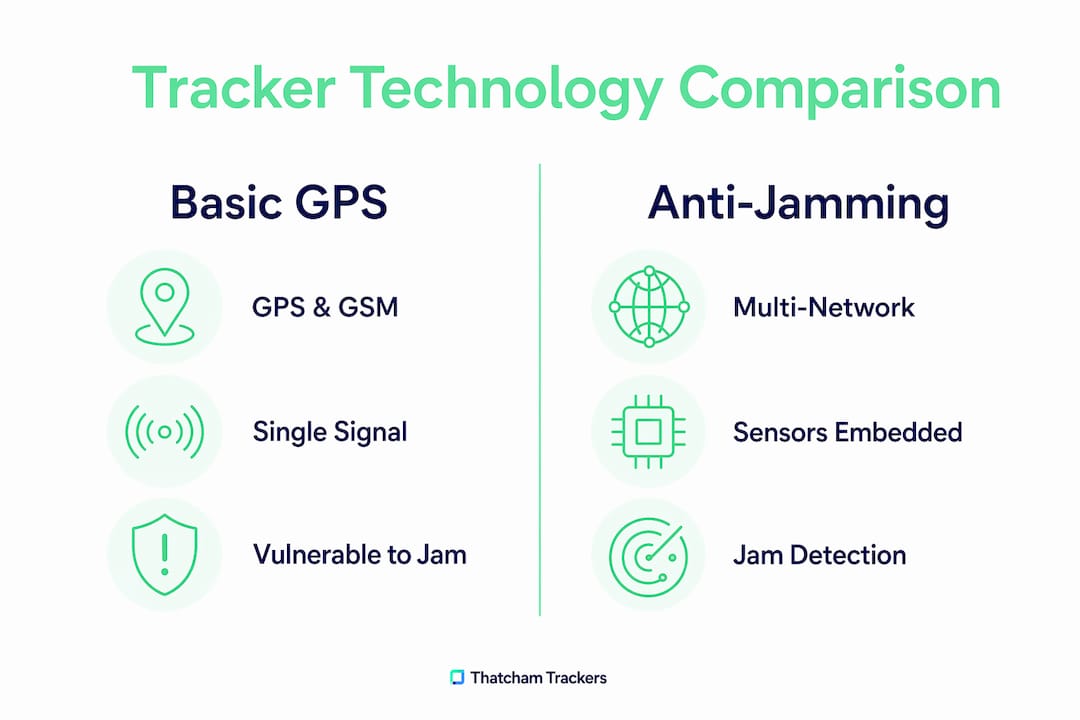
Anti-jamming tracker technology works by continuously monitoring the signal environment and triggering fallback protocols the instant jamming is detected. The system analyses signal patterns and noise floor changes to identify interference almost instantly, then sends alerts to a 24-hour monitoring centre. That near-instant detection is what separates a hardened stolen vehicle recovery (SVR) system from a basic GPS logger.
Detection alone is not enough. Once jamming is confirmed, the tracker switches to multi-network fallback methods to maintain location data. These methods include:
- Cellular triangulation via GSM networks, which operate on entirely different frequencies to GNSS signals
- Bluetooth Low Energy (BLE) beaconing for short-range position confirmation in urban areas
- VHF radio transmission, which jammers cannot block without specialist military-grade equipment
- Satellite network switching, moving between GPS, GLONASS, and Galileo constellations to find an unblocked signal
Sensor integration provides a third layer of resilience. Advanced SVR systems embed accelerometers and gyroscopes that log movement data continuously. If every radio signal is lost, the tracker uses dead reckoning technology to calculate the vehicle’s probable position from speed, direction, and elapsed time. That movement history gives police a credible search area even when the vehicle is inside a signal-blocking container or underground car park.
Pro Tip: Covert, battery-powered secondary units placed in hidden vehicle locations provide continuity of location data when a primary unit is cut or jammed. A layered approach using two or more units in separate locations is the most reliable configuration.
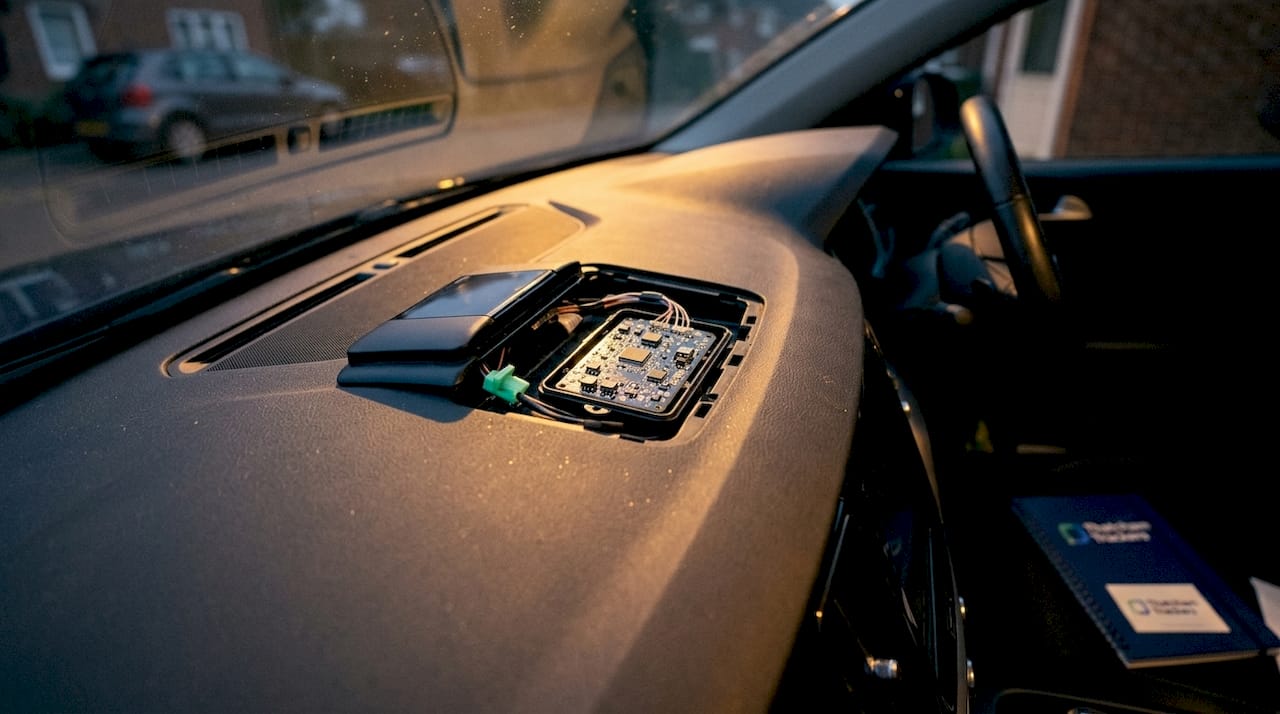
Firmware-level mitigation adds a further defence. Modern receivers apply signal processing algorithms that distinguish genuine satellite signals from jamming noise, rejecting interference before it corrupts position data. The result is a system that treats jamming as a trigger for action rather than a point of failure.
How do anti-jamming trackers support stolen vehicle recovery?
Anti-jamming trackers directly improve stolen vehicle recovery rates by maintaining reliable location data through the entire theft event. A VHF, GPS, and GSM multi-technology approach supports a recovery success rate above 95%, with 80% of recovered vehicles returned within four hours. Those figures are only achievable because the tracker continues transmitting even when thieves deploy jammers.
Police integration is the mechanism that converts tracking data into physical recovery. UK law enforcement uses over 2,000 patrol vehicles and all police helicopters equipped with detection units capable of identifying signals from advanced SVR systems. That infrastructure means a tracker does not need to broadcast its exact GPS coordinates. VHF signals are detectable by patrol vehicles driving within range, even if the vehicle is inside a building or shipping container.
The collaboration between tracking providers and police follows a structured process:
- The monitoring centre receives a jamming or theft alert and contacts the registered owner to confirm theft
- Police are notified with the last confirmed position and any dead reckoning data
- Patrol vehicles and helicopters use onboard detection units to home in on the VHF signal
- The vehicle is located and secured, often before the thief reaches their destination
“Anti-jamming technology’s effectiveness depends heavily on deep integration with police infrastructure, enabling real-time detection and coordinated recovery. Without that infrastructure, even the most technically advanced tracker is limited to providing historical data rather than live pursuit capability.”
The legal context reinforces this collaboration. The Crime and Policing Act 2026 allows police to seize jamming devices before a crime is committed, placing the burden of proof on the possessor to demonstrate legitimate use. That shift in legal burden disrupts the supply chain of jammers reaching organised theft gangs.
Anti-jamming trackers vs basic GPS trackers: advantages and limitations
The core difference between a basic GPS tracker and an anti-jamming SVR system is resilience under deliberate attack. A basic GPS tracker relies on a single GNSS signal and a single GSM data connection. A cheap jammer, readily available online, effectively blinds that system within seconds. An anti-jamming SVR system treats signal loss as an expected condition and responds with pre-programmed fallback protocols.
| Feature | Basic GPS tracker | Anti-jamming SVR system |
|---|---|---|
| Signal networks | GPS and GSM only | GPS, GSM, VHF, BLE, multi-constellation |
| Jamming response | Signal lost, no data | Fallback networks activated, alert sent |
| Sensor backup | None | Accelerometer and gyroscope dead reckoning |
| Police integration | None | VHF detection by patrol vehicles and helicopters |
| Monitoring | Self-monitored app | 24-hour professional monitoring centre |
| Certification | None required | Thatcham Research S5 or S7 category |
Consumer connected car apps lack the hardened, redundant communications of dedicated SVR systems and should not be relied on as security assets. That gap between consumer expectation and actual capability is where most vehicle owners are exposed.
Anti-jamming systems do carry genuine limitations. Battery-powered covert units require periodic maintenance to confirm charge status. Physical tampering, such as a thief locating and removing the primary unit, remains a risk if installation is not sufficiently covert. AI-enabled alert filtering in fleet platforms reduces false alarms from motion and tamper sensors, but consumer-grade systems may still generate nuisance alerts that owners learn to ignore.
Pro Tip: Never rely on a single tracker unit. A Thatcham Research-certified S5 or S7 device combined with a covert secondary unit in a separate hidden location provides the layered security that professional thieves cannot easily defeat.
The types of vehicle tracking technology available in 2026 range from basic self-monitored GPS loggers to fully certified SVR systems with police integration. Understanding that spectrum is the first step to choosing the right level of protection.
How is UK legislation addressing GPS jamming devices?
UK legislation is moving from reactive prosecution to proactive prevention. Previously, police needed evidence that a jammer had been used in a crime before they could act. The Crime and Policing Act 2026 changes that position fundamentally.
The key provisions relevant to anti-jamming tracker technology are:
- Possession offences: owning an electronic theft device, including a GPS jammer, is now a criminal offence carrying up to five years’ imprisonment
- Seizure powers: police can confiscate jamming devices without needing to prove they were used in a specific crime
- Burden of proof: the possessor must demonstrate a legitimate use case, reversing the previous evidential requirement on police
- Interference with emergency services: jamming devices that disrupt blue-light communications carry additional charges under existing communications legislation
The UK government had already signalled its intent to ban jammer possession before the Act was passed, citing widespread criminal misuse and interference with emergency service communications. That political momentum translated directly into the 2026 legislation.
The practical impact on criminal gangs is significant. Organised theft operations depend on cheap, freely available jammers to neutralise standard trackers. Criminalising possession disrupts procurement and raises the operational risk for gang members who previously carried jammers without legal consequence. Thatcham Research has called for further industry collaboration to build on the legislative foundation, recognising that law alone cannot outpace criminal adaptation.
Key takeaways
Anti-jamming tracker technology is the only reliable defence against GPS jamming attacks, and its effectiveness depends on multi-network fallback, sensor-based dead reckoning, and direct integration with UK police detection infrastructure.
| Point | Details |
|---|---|
| Jamming is a real and cheap threat | Signal jammers are readily available and immediately blind single-network GPS trackers. |
| Multi-network fallback is essential | Effective systems switch between GPS, GSM, VHF, and BLE to maintain tracking under interference. |
| Dead reckoning fills the gap | Accelerometers and gyroscopes log movement data when all radio signals are lost, guiding police to a search area. |
| Police integration drives recovery | Over 2,000 UK patrol vehicles and all police helicopters carry VHF detection units for SVR system signals. |
| Legislation now supports prevention | The Crime and Policing Act 2026 criminalises jammer possession, shifting the legal burden onto the possessor. |
Thatcham Trackers’ view on anti-jamming technology
The security industry has a credibility problem with consumers. Most drivers assume that any tracker, including the connected car app bundled with their vehicle, provides meaningful theft protection. The reality is that a jammer costing less than the price of a tank of fuel renders the majority of consumer-grade trackers completely silent within seconds of a theft beginning.
What concerns us most is the confidence gap. Drivers who believe they are protected behave differently from drivers who know they are not. They park in higher-risk locations, they skip additional security measures, and they are genuinely shocked when their vehicle disappears without a single alert. That false confidence is more dangerous than no tracker at all.
The answer is not simply buying a more expensive device. It is understanding that vehicle security in 2026 requires layers: a Thatcham Research-certified SVR system with VHF capability, a covert secondary unit, and ideally a physical immobiliser that prevents the vehicle from being driven away even if the tracker is defeated. The insurance requirements for Thatcham-approved trackers exist precisely because insurers have the claims data to know which systems actually work.
The Crime and Policing Act 2026 is a genuine step forward, but legislation follows criminal behaviour rather than leading it. Gangs will adapt. The technology must stay ahead of them, and that means investing in certified, police-integrated SVR systems rather than convenience apps.
— Thatcham Trackers
Thatcham Trackers and certified anti-jamming protection
Thatcham Trackers supplies Thatcham Research-certified devices across the S5, S5 Plus, and S7 categories, all of which include multi-network connectivity and professional 24-hour monitoring.

Every device in the Thatcham-approved tracker range is independently tested and certified by Thatcham Research, the UK’s central automotive risk intelligence organisation. Certification confirms that the device meets the signal resilience, police integration, and monitoring standards that insurers require and that criminals cannot easily defeat. Thatcham Trackers works with approved installers across the UK to fit devices in covert locations, maximising the layered security that professional recovery depends on. For drivers who need the highest level of protection, the Thatcham Approved S5 Plus combines advanced anti-jamming capability with full police network integration.
FAQ
What is GPS jamming in the context of vehicle theft?
GPS jamming is the deliberate transmission of radio noise on GNSS frequencies to prevent a tracker from receiving satellite signals. Thieves use cheap, widely available devices to blind standard trackers before or during a theft.
How does anti-jamming technology work in a vehicle tracker?
Anti-jamming systems detect interference through signal-pattern analysis, then switch to fallback networks including GSM, VHF, and BLE. Embedded accelerometers and gyroscopes log dead reckoning data to maintain a movement history when all radio signals are blocked.
What is the difference between an S5 and S7 Thatcham tracker?
Thatcham Research’s S5 category covers SVR systems with professional monitoring and police integration. The S7 category adds driver identification and higher-grade tamper resistance. Both categories require multi-network connectivity and independent certification.
Is it illegal to own a GPS jammer in the UK?
The Crime and Policing Act 2026 makes possession of electronic theft devices, including GPS jammers, a criminal offence carrying up to five years’ imprisonment. Police can now seize devices without needing evidence of a specific crime.
Do anti-jamming trackers help with insurance premiums?
Thatcham Research-certified trackers are recognised by UK insurers as evidence of reduced theft risk. Many insurers require or reward Thatcham-approved devices with lower premiums, particularly for high-value or high-risk vehicles.