

GPS trackers are hidden from thieves because a visible device can be found and disabled in under 60 seconds, ending any chance of vehicle recovery before police are even called. Concealment is not a bonus feature. It is the core security principle that separates a tracker that works from one that gives false confidence. Thatcham Research, the UK’s central automotive risk intelligence organisation, independently tests and certifies vehicle security systems. Devices carrying Thatcham approval are built to resist exactly this kind of rapid defeat. If you own a car or motorhome, understanding why trackers must be hidden is the first step to choosing one that actually protects your vehicle.
Why trackers hidden from thieves must be concealed
Professional vehicle thieves do not guess. They follow a method. The moment a vehicle is taken, the clock starts on a well-practised process designed to neutralise any tracking device before the owner notices the car is gone.
The first tactic is physical. Thieves conduct systematic sweeps of the most predictable hiding spots: under the chassis, along frame rails, behind wheel arches, and near the OBD-II diagnostic port. These locations appear in online guides and are well known to organised theft rings. A tracker placed in any of these spots provides only the illusion of security.

The second tactic is electronic. Signal jammers create a 30–90 minute blackout during which the tracker cannot transmit its location. This window gives thieves enough time to move the vehicle into a shielded structure, such as a shipping container or a prepared garage, where the device is then physically removed. Jamming cannot be completely prevented, which is why the physical concealment of the tracker matters so much.
The third tactic targets convenience. The OBD-II port, located under the dashboard, is a popular spot for plug-in trackers because installation requires no tools. Thieves know this. A plug-in unit can be removed in seconds. Any tracker that does not require tools to access is a tracker that a thief can defeat without slowing down.
- Physical sweep of common locations (under 2 minutes)
- Electronic jamming to block signal transmission (30–90 minutes)
- OBD-II port check and plug-in removal (under 30 seconds)
- Transfer to shielded location for final disablement
The pattern is consistent. Trackers installed in predictable places fail within 48 hours of theft. Concealment in an unpredictable, tool-dependent location is the single most effective counter to this process.
How hidden tracker technology differs from visible units
Not all trackers are built for concealment. The technology inside a device determines how well it survives an organised theft attempt.
| Feature | Visible or plug-in unit | Concealed hardwired unit |
|---|---|---|
| Power source | Battery or OBD-II port | 12V vehicle wiring |
| Removal time | Under 30 seconds | Requires tools and disassembly |
| Tamper alert | Rarely included | Standard on quality units |
| Battery life | Days to weeks | Indefinite via hardwiring |
| Mounting method | Magnetic or plug-in | Fixed behind trim or in cavities |
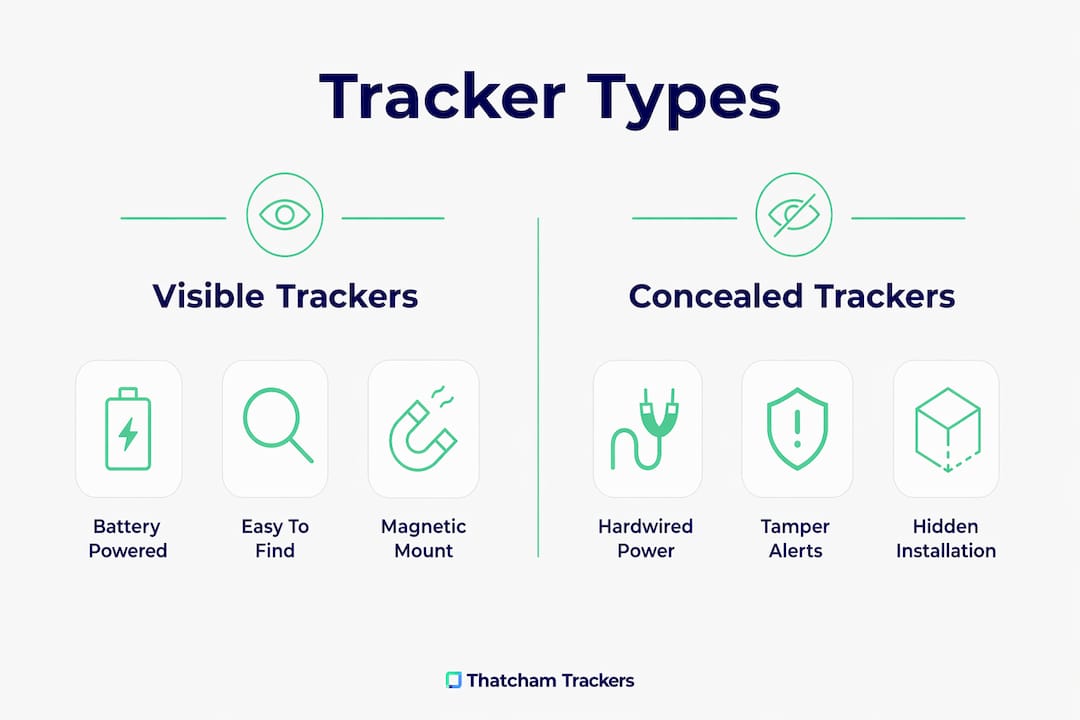
Hardwired 12V trackers offer continuous power and instant tamper notification. They do not run out of charge and cannot be unplugged. Battery-powered units, while useful as secondary devices, require periodic charging and are more vulnerable to discovery if placed in accessible spots.
Magnetic mounts are a particular weakness. Magnetic mounting restricts placement to exposed metal surfaces, which are exactly the areas thieves check first. Magnetic mounts can also trigger sensor inaccuracies and create electronic interference. Non-magnetic mounting inside interior trim or within structural cavities removes the device from predictable search zones entirely.
Tamper and offline alerts are the technology feature that changes the game most. Advanced trackers send instant notifications if the device is disconnected or loses connectivity. This means even if a jammer is active, the owner receives an alert the moment the signal drops. That notification is often the first sign a theft is in progress.
Pro Tip: Choose a hardwired tracker with both tamper alerts and offline notifications. The combination means you are alerted the moment a thief interferes with the device, even before they have left your street.
Where and how to hide trackers in cars and motorhomes
Effective concealment means placing a tracker where a thief would need tools and time to find it. Location choice is as important as the device itself.
Locations to avoid
- Glovebox or centre console (first places searched)
- Under the driver or passenger seat (standard sweep location)
- Wheel arches (exposed to physical and electronic detection)
- OBD-II port (removed in seconds, no tools needed)
- Visible chassis rails (predictable and accessible)
Locations that work
- Behind dashboard trim panels, requiring panel removal
- Inside structural pillars (A, B, or C pillars) with factory trim replaced
- Within the engine bay, secured to non-magnetic surfaces away from heat
- Beneath fixed floor panels or under permanently fitted furniture in motorhomes
- Inside roof linings where wiring can be routed discreetly
For motorhome owners, the challenge is greater. Larger vehicles have more surface area, which sounds like an advantage. In practice, it means more predictable cavities that experienced thieves know to check. The specialist considerations for large vehicles differ significantly from standard car installations. Fixed furniture, habitation wiring, and access hatches all create both opportunities and risks.
Using two trackers in separate locations is the most reliable approach. One device can be placed in a less concealed spot as a decoy. The second is hidden in a location requiring full disassembly to reach. Thieves stop searching after disabling the first tracker they find, which leaves the second device active and transmitting.
Pro Tip: Never tell anyone outside your household exactly where your tracker is installed. The location is only secure if it remains unknown. Even well-meaning conversations can create a vulnerability.
The quality of the installation matters as much as the location. A poorly routed wire or a loose panel can reveal the device during a routine search. Professional installation by a certified technician reduces this risk significantly and is often required for insurance approval under Thatcham standards.
How hidden trackers fit into a complete vehicle security plan
A hidden tracker works best as one layer within a broader security approach. Relying on a single device, however well concealed, leaves gaps that determined thieves can exploit.
The most effective structure combines a visible deterrent with a covert backup. A visible tracker or security sticker signals that the vehicle is monitored. The dual-layer approach exploits thief assumptions: once the visible device is found and disabled, the thief believes the job is done. The hidden unit continues to transmit.
Key elements of a complete security plan:
- A Thatcham-approved tracker installed in a concealed, tool-dependent location
- A secondary visible deterrent, such as a steering lock or visible OBD-II device
- Tamper and offline alerts configured to notify you immediately
- Encrypted data transmission and two-factor authentication on the tracking platform
- Regular checks to confirm the device is powered and connected
Insurance is a direct financial reason to prioritise concealment. Thatcham Research certifies devices at different security levels, from S5 through to S7. Insurers use these ratings to assess theft risk. A Thatcham-approved device, correctly installed, can reduce your premium or satisfy a policy requirement entirely. The insurance best practices for 2026 make clear that installation quality and device certification both affect whether a claim is supported after theft.
“A tracker is part of a broader risk management approach, requiring owners to prioritise platforms with data security features to avoid privacy liabilities.”
Signal jamming cannot be eliminated as a threat. The correct response is not to assume jamming will not happen, but to configure the tracker so that any jamming attempt triggers an immediate alert. [Offline and tamper alerts](https://hubble.com/community/guides/why-stolen-vehicle-trackers-get-defeated-in-48 hours/) are the direct counter to this tactic. Without them, a jammer renders even the best-hidden tracker silent until the signal returns, which may be too late.
Key takeaways
A hidden, hardwired, Thatcham-approved tracker with tamper alerts is the most reliable defence against organised vehicle theft in the UK.
| Point | Details |
|---|---|
| Concealment prevents rapid defeat | Visible trackers are disabled in under 60 seconds; hidden units require tools and time to find. |
| Jamming demands tamper alerts | Signal jammers block transmission for 30–90 minutes; tamper alerts notify you the moment connectivity drops. |
| Location choice is critical | Avoid predictable spots like OBD-II ports and wheel arches; use structural cavities requiring disassembly. |
| Dual trackers increase recovery odds | A visible decoy plus a covert backup exploits thief assumptions and keeps one device active. |
| Thatcham approval matters for insurance | Certified devices satisfy insurer requirements and can reduce premiums under UK policy standards. |
The reality of tracker concealment: what experience shows
Thatcham Trackers has seen a consistent pattern across thousands of installations. Owners who fit a tracker and assume the job is done are the ones who call after a theft to say the device was found and removed within hours. The misconception is that “hidden” means tucked under a seat or clipped behind the dashboard. Thieves have memorised those locations. True concealment means placing a device where disassembly is required, in a location that does not follow any published guide.
The second misconception is about jamming. Owners often believe that because their tracker has a strong signal in normal use, it will transmit during a theft. A jammer changes that entirely. The tracker that sends an alert the moment it goes offline is worth far more than one that only transmits when conditions are ideal.
Periodic checks are underestimated. A tracker installed two years ago may have a loose connection, a drained backup battery, or a subscription that has lapsed. None of these failures are visible from the outside. A theft prevention strategy that includes scheduled device checks is more reliable than one that assumes the hardware is always ready.
The combination of quality hardware, professional installation, and the right security habits is what actually protects a vehicle. Technology alone does not outsmart a professional thief. Technology plus unpredictability does.
— Thatcham Trackers
Thatcham Trackers: approved devices built for concealment
Choosing the right tracker means choosing one that is certified, designed for hidden installation, and recognised by your insurer.

Thatcham Trackers supplies a full range of Thatcham-approved trackers certified by Thatcham Research, the independent body that sets the security standards UK insurers rely on. Every device in the range is built for concealed, hardwired installation with tamper alert capability. The Thatcham S5 system and the S7 collection cover different certification levels to match your insurer’s requirements. Whether you drive a car or a motorhome, the right certified device is available, and professional installation is part of the service.
FAQ
Why are GPS trackers hidden from thieves?
GPS trackers are hidden because a visible device can be disabled in under 60 seconds using simple tools. Concealment forces thieves to spend time searching, which increases the chance of recovery.
What is the best location to hide a tracker in a car?
The best locations are inside structural pillars, behind dashboard trim panels, or within the engine bay, all requiring tools to access. Avoid the OBD-II port, glovebox, and wheel arches, as these are checked first.
Can thieves detect hidden trackers with jammers?
Signal jammers block GPS and cellular transmission for 30–90 minutes but cannot physically locate a well-hidden device. A tracker with offline and tamper alerts will notify the owner the moment jamming begins.
Does a hidden tracker affect my car insurance?
A Thatcham-approved tracker, correctly installed, can satisfy insurer requirements and reduce premiums. Thatcham Research certifies devices at S5, S5 Plus, and S7 levels, which insurers use to assess theft risk.
How many trackers should I fit to my vehicle?
Fitting two trackers, one visible and one fully concealed, is the most effective approach. Thieves typically stop searching after disabling the first device they find, leaving the hidden unit active.